
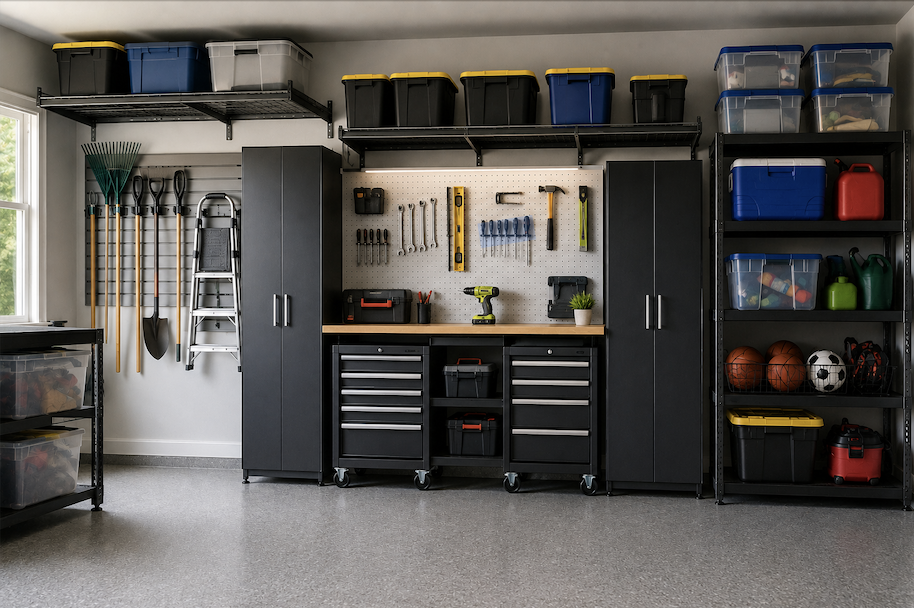
The garage tends to become the default dumping ground for anything that doesn’t have an obvious home elsewhere in the house. Unlike a closet or kitchen drawer, there’s rarely a natural system guiding what goes where, which is exactly why garages accumulate clutter faster than almost any other space. Fixing this doesn’t require an expensive renovation, it requires a system, and a few key storage tools used consistently.
Why Garages Become Clutter Magnets
Garages combine several different categories of storage, tools, seasonal items, sports equipment, vehicle supplies, overflow from the house, without a built-in system for separating them, unlike a kitchen with its cabinets and drawers designed around specific categories. Without intentional zones, everything ends up in whatever open space is available at the time, which is how a garage slowly becomes unusable for its original purpose.
Start With a Full Clear-Out
Before buying any storage system, remove everything from the garage and sort it into three categories: keep, donate or sell, and discard. This step is uncomfortable but necessary, organizing clutter you don’t actually need just results in a more organized version of the same problem. Items that haven’t been used in over a year, expired chemicals or paints, and broken tools that were never going to be repaired are common candidates for the discard pile.
The Zone-Based Approach
Rather than organizing item by item, divide the garage into zones based on category: a tool zone, a sports and recreation zone, a seasonal storage zone, an automotive supplies zone, and a yard and garden zone. Assigning each category a specific area, even if it’s just a section of wall or a corner, makes it far easier to put things back in the right place and to notice quickly when something has ended up somewhere it doesn’t belong.
Place frequently used items (tools you reach for weekly, sports equipment used regularly) in the most accessible spots, and reserve harder-to-reach areas, like high shelving or overhead storage, for genuinely infrequent items like holiday decorations.
Wall Storage: The Highest-Impact Change
Getting items off the floor and onto the walls is usually the single biggest improvement a cluttered garage can make. Pegboards are especially effective for tools, since they keep frequently used items visible and within reach while freeing up floor and shelf space entirely.
Slatwall panel systems are a step up from pegboard in durability and weight capacity, and are worth considering for garages with heavier equipment or a larger volume of tools, though they typically cost more than a basic pegboard setup. For most homeowners, a pegboard section combined with a few wall-mounted shelves covers the majority of storage needs without a large investment.
Overhead Storage for Seasonal Items
Ceiling-mounted storage racks take advantage of space that’s otherwise completely unused, making them ideal for items you only need a few times a year: holiday decorations, camping gear, or luggage. Since these items don’t need to be easily accessible day to day, moving them overhead frees up significant floor and wall space for things you actually use regularly.
When installing overhead storage, always confirm it’s securely anchored into ceiling joists rather than drywall alone, since overhead storage carries real weight directly above where people and vehicles are underneath it.
Bins, Labeling, and Category Consistency
Clear, uniform storage bins make it far easier to see contents at a glance than a mix of cardboard boxes and mismatched containers. Labeling each bin clearly, ideally on more than one side so it’s visible regardless of how it’s shelved, saves time searching later and makes it easier for other household members to actually maintain the system rather than reverting to piling things randomly.
Grouping bins by the zones established earlier, rather than by size or whatever container happens to be available, reinforces the overall system rather than working against it.
Lighting and Workspace Considerations
A garage that also functions as a workspace benefits significantly from improved lighting, since most garages are built with minimal overhead lighting that’s adequate for parking a car but not for detailed tasks. Adding a few LED shop lights along the workspace area is a relatively inexpensive upgrade that makes the space more usable and makes it easier to actually see what’s stored where, particularly in corners or on higher shelving.
Handling Hazardous Materials Safely
Garages often accumulate paint cans, chemicals, and fuel containers that need specific storage considerations beyond a standard shelf. Keeping flammable materials away from heat sources or electrical equipment, storing chemicals upright and clearly labeled, and periodically checking expiration dates on anything hazardous prevents both safety issues and the kind of clutter that accumulates from forgotten, unusable products taking up shelf space indefinitely.
Planning Storage Around Future Needs
It’s worth leaving some flexibility in a new storage system rather than filling every available inch immediately. Households tend to acquire new equipment over time, a new bike, new sports gear, a seasonal purchase, and a system with zero spare capacity often ends up right back on the floor within a year. Leaving a small amount of open shelf or floor space specifically for future additions makes the system easier to maintain long-term.
Reassessing Zones After the First Few Months
It’s common for the initial zone layout to need small adjustments once you’ve actually lived with the system for a while, a zone that seemed logical on paper might turn out to be inconvenient in practice, or a category might need to be split into two once you see how much actually belongs to it. Treating the first version of the system as a draft, and giving yourself permission to adjust it after a few months of real use, leads to a setup that fits your actual habits rather than an idealized version of them.
Dealing With Vehicles and Floor Space
If vehicle parking is a priority, map out the actual footprint needed for each car before deciding where storage systems go, rather than fitting storage in first and hoping the vehicles still fit comfortably. A floor marked with tape during the planning stage can help visualize this before committing to shelf or cabinet placement.
Rolling storage carts or modular cabinets on wheels can be a useful compromise in tighter garages, since they allow storage to be repositioned temporarily when extra floor space is needed for a specific project.
Choosing Between Open Shelving and Closed Cabinets
Open shelving is generally more affordable and easier to install than closed cabinetry, and it allows for quicker visual scanning of contents. Closed cabinets cost more but keep items free of dust and out of sight, which can be worth it for anything you’d rather not have visible from the driveway when the garage door is open, or for households that prefer a cleaner overall appearance over maximum accessibility.
Labeling Systems That Actually Get Used
A labeling system only works if it’s simple enough to maintain consistently. Handwritten labels on painter’s tape are a low-cost, flexible option that can be updated easily as categories change, while a label maker gives a more polished, durable result for a system you don’t expect to change often. Whichever method you choose, keeping label wording short and using the same category names established in your zone system, rather than inventing new descriptions each time, keeps the whole system easier to navigate.
Budget vs Premium Storage Systems
A basic setup using pegboard, a few wall shelves, and stackable bins can meaningfully transform a cluttered garage at a relatively low cost, and is a reasonable starting point for most homeowners. Premium modular cabinet systems, overhead motorized lift storage, and custom-built slatwall setups offer a more polished, integrated look and typically more storage capacity, but represent a significantly larger investment that’s worth it primarily for garages with heavy, ongoing storage needs or for homeowners planning to use the garage as a dedicated workshop space.
Vertical Storage for Long or Awkward Items
Ladders, long-handled tools, lumber scraps, and similar awkwardly shaped items rarely fit neatly on standard shelving. Wall-mounted vertical racks or brackets designed specifically for these shapes keep them organized and out of the way, rather than leaning in a corner where they’re prone to falling or blocking access to other storage. This is a relatively small addition that solves a surprisingly common source of garage clutter.
Involving the Whole Household From the Start
A garage organization system designed and set up by one person, without input from everyone who uses the space, is more likely to break down over time simply because not everyone understands the logic behind it. Walking other household members through the zones and labeling system once it’s set up, rather than assuming it’s self-explanatory, meaningfully improves how well the system holds up months later.
Maintaining the System Long-Term
The most common reason garage organization fails isn’t a bad initial system, it’s a lack of habit afterward. Setting a recurring seasonal check-in, even just twice a year, to return misplaced items to their zones and reassess whether anything has drifted back into clutter keeps the system functional over time. Involving the whole household in understanding where things belong also matters, since a system only one person understands tends to break down as soon as someone else puts something away.
Conclusion
An organized garage comes down to zones, wall and overhead storage that gets clutter off the floor, and a labeling system consistent enough that anyone in the household can maintain it. None of this requires a full renovation, a clear-out, some pegboard, a handful of labeled bins, and a bit of ongoing maintenance will transform most garages without a major budget.
- Read more about Newolt!