Most skincare disappointment traces back to one root cause: using products that don’t match your actual skin type. A serum that works wonders for someone with oily skin can leave dry skin feeling tighter and more irritated, and a rich, heavy cream beloved by dry-skin users can leave oily skin looking shinier and more congested within hours. Before buying anything new, it’s worth spending five minutes figuring out what you’re actually working with.
Why Skin Type Matters More Than Trends
Skincare trends move quickly, and a product that’s popular online isn’t automatically right for every skin type. The ingredient lists, textures, and marketing claims that make a product appealing on social media rarely mention who it’s actually formulated for, which is part of why so many people end up with a shelf of expensive products that don’t work for their specific skin.
The Five Main Skin Types
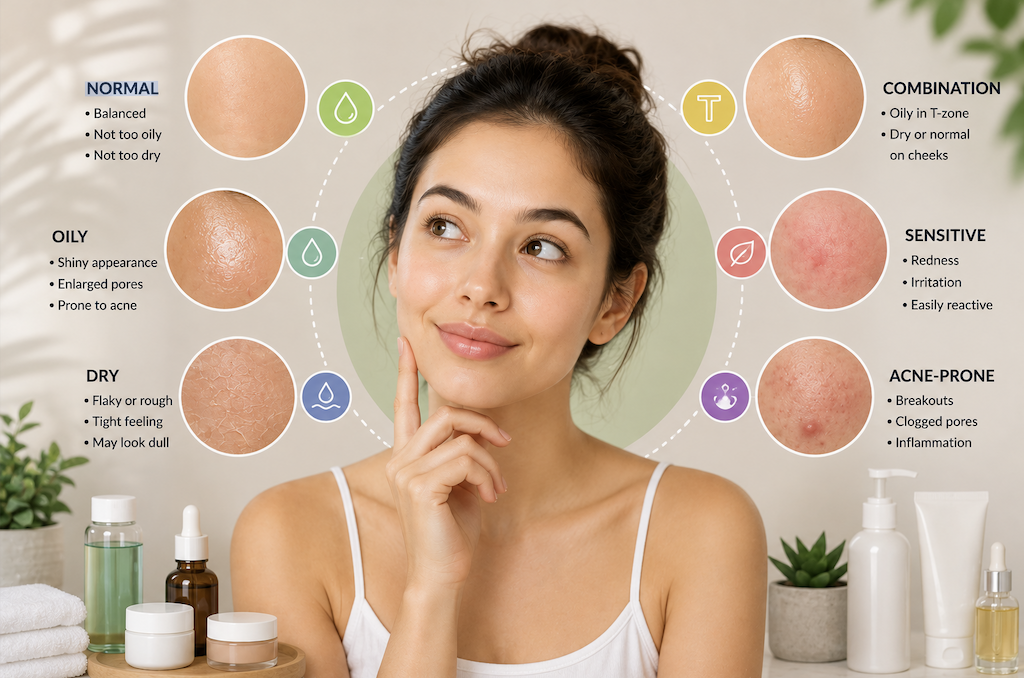
Normal skin is neither oily nor dry, with small, barely visible pores and few sensitivity issues. It’s the least common type and the easiest to care for, generally tolerating a wide range of products without much reaction.
Dry skin tends to feel tight, especially after cleansing, and can show flaking or rough texture, particularly around the cheeks and forehead. It often looks less plump and can show fine lines more visibly than other skin types, especially in dry climates or during winter months.
Oily skin produces excess sebum, leading to visible shine, especially in the T-zone (forehead, nose, and chin), and often has larger, more visible pores. It’s more prone to blackheads and acne but also tends to show fewer fine lines over time, since the extra oil provides some natural moisture retention.
Combination skin is oily in some areas, typically the T-zone, and normal or dry in others, typically the cheeks. This is one of the most common skin types and often the most confusing to shop for, since a single product rarely addresses both needs equally well.
Sensitive skin reacts easily to new products, environmental changes, or certain ingredients, often with redness, itching, or a burning sensation. Sensitive skin can technically overlap with any of the other four types, someone can have sensitive-oily skin or sensitive-dry skin, for example.
A Simple At-Home Test
One of the most reliable ways to identify your skin type doesn’t require any products at all. Wash your face with a gentle cleanser, pat it dry, and don’t apply anything else for about an hour. After that hour, check how your skin looks and feels.
If your skin feels tight or looks flaky in places, that points toward dry skin. If it looks shiny across the whole face, particularly on the forehead and nose, that points toward oily skin. If the shine is limited to the T-zone while the cheeks feel comfortable or slightly tight, that suggests combination skin. If your skin feels comfortable without tightness or noticeable shine anywhere, that’s a sign of normal skin.
This test works best done in the morning, since nighttime products and pillow contact can affect how skin looks and feels later in the day, making the results less reliable if done in the evening.
A Note on the Blotting Sheet Method
Another common approach uses blotting sheets, pressed against different areas of the face after cleansing. More oil transferred from the T-zone than the cheeks suggests combination skin; oil transferred evenly across the whole sheet suggests oily skin; little to no oil transfer anywhere suggests dry or normal skin. This method can be a useful supplement to the hour-wait test above, particularly for anyone who wants a more visual confirmation of their results.
Adjusting Your Routine as Skin Type Shifts
Since skin type can change gradually, it’s worth periodically reassessing rather than assuming your products from a year or two ago still fit. A practical approach is repeating the simple at-home test described earlier every few months, or whenever you notice your regular products suddenly feel wrong, too heavy, not hydrating enough, or causing new breakouts. Catching this shift early makes it easier to adjust gradually rather than overhauling an entire routine all at once.
How Diet and Hydration Play a Supporting Role
While topical products address skin from the outside, overall hydration and diet can influence how skin looks and feels, though they’re not a substitute for a routine matched to your actual skin type. Skin that looks temporarily dull or dry isn’t always a sign your skin type has changed, sometimes it reflects short-term factors like reduced water intake, poor sleep, or seasonal changes, which is worth distinguishing from a genuine long-term shift in skin type before switching products entirely.
Common Misconceptions About Skin Type
A common misconception is that oily skin doesn’t need moisturizer. In reality, skipping moisturizer on oily skin can actually increase oil production, as skin tries to compensate for the lack of external hydration. Oily skin generally benefits from a lightweight, oil-free moisturizer rather than no moisturizer at all.
Another misconception is that dry skin can’t also be acne-prone. Dry, dehydrated skin can still develop breakouts, particularly if the skin barrier is compromised, which is why acne alone isn’t a reliable indicator of oily skin specifically.
It’s also a common mistake to assume skin type is permanent. In reality, skin type can shift with age, climate, hormonal changes, and even the products you’re currently using, someone who had oily skin in their twenties may find their skin trends drier by their forties, which is why it’s worth periodically reassessing rather than assuming your skin type from years ago still applies.
How Climate and Season Affect Skin Type
Skin can behave differently depending on humidity and temperature, even for the same person. Skin that feels balanced in a humid summer climate might feel noticeably drier during a cold, dry winter, particularly with indoor heating running. This is why some people find they need a lighter moisturizer in summer and a richer one in winter, rather than assuming their skin type is fixed year-round.
Choosing Products Based on Your Type
For dry skin, look for cream-based cleansers, moisturizers with ceramides or hyaluronic acid, and avoid alcohol-based toners or products with strong fragrance, which can further dry out the skin.
For oily skin, gel-based cleansers, oil-free and non-comedogenic moisturizers, and clay-based masks used occasionally can help manage excess oil without over-stripping the skin.
For combination skin, consider using different products on different zones, or a lightweight, balanced formula designed specifically for combination skin that won’t over-dry the cheeks or over-hydrate the T-zone.
For sensitive skin, fragrance-free, minimal-ingredient formulas reduce the chance of reaction, and introducing new products one at a time, rather than several at once, makes it much easier to identify the specific cause if irritation does occur.
How Hormones and Age Affect Skin Type Over Time
Hormonal fluctuations, whether from puberty, pregnancy, menstrual cycles, or aging, can shift skin type noticeably over relatively short periods. It’s common for oil production to increase during hormonal shifts and for skin to trend drier with age, as natural oil production tends to slow down over time. This is part of why a skincare routine that worked well five or ten years ago may no longer suit your skin today, independent of anything you’re doing wrong.
Testing for Sensitivity Specifically
Since sensitivity can occur alongside any of the other skin types, it’s worth testing for it separately. A simple approach is applying a small amount of a new product to the inside of your wrist or along your jawline and waiting 24 to 48 hours before applying it to your full face. Redness, itching, stinging, or small bumps at the test site are signs of sensitivity to that specific product or ingredient, and it’s worth noting which ingredient was involved so you can watch for it in other products going forward.
Skin Type Can Vary Across Your Face
It’s worth checking more than one area of your face during any at-home test, since skin type isn’t always uniform. The forehead and nose often behave differently from the cheeks and jawline, and the skin around the eyes is typically thinner and more prone to dryness than the rest of the face regardless of your overall skin type, which is part of why eye creams are often formulated differently from regular facial moisturizers.
When Skin Type Alone Isn’t Enough
Skin type describes oil and moisture levels, but it’s a separate concept from skin concerns like acne, hyperpigmentation, or signs of aging, which can occur in any skin type. Someone with oily skin can also have sensitivity issues, and someone with dry skin can also struggle with acne. It’s worth identifying both your skin type and any specific concerns separately, rather than assuming one automatically explains the other.
When to See a Dermatologist
Persistent, painful, or worsening skin issues, including severe acne, unexplained rashes, or chronic irritation that doesn’t improve with basic changes, are worth discussing with a dermatologist rather than continuing to experiment with over-the-counter products. A professional can also confirm your skin type more precisely and identify any underlying conditions that at-home testing wouldn’t catch.
Conclusion
Understanding your skin type is the foundation that makes every other skincare decision easier and more effective. A simple at-home test, done without any product on freshly cleansed skin, gives most people a reasonably accurate read. From there, choosing products formulated for your specific type, rather than whatever’s trending, will save both money and frustration.
- Read more about Newolt!