
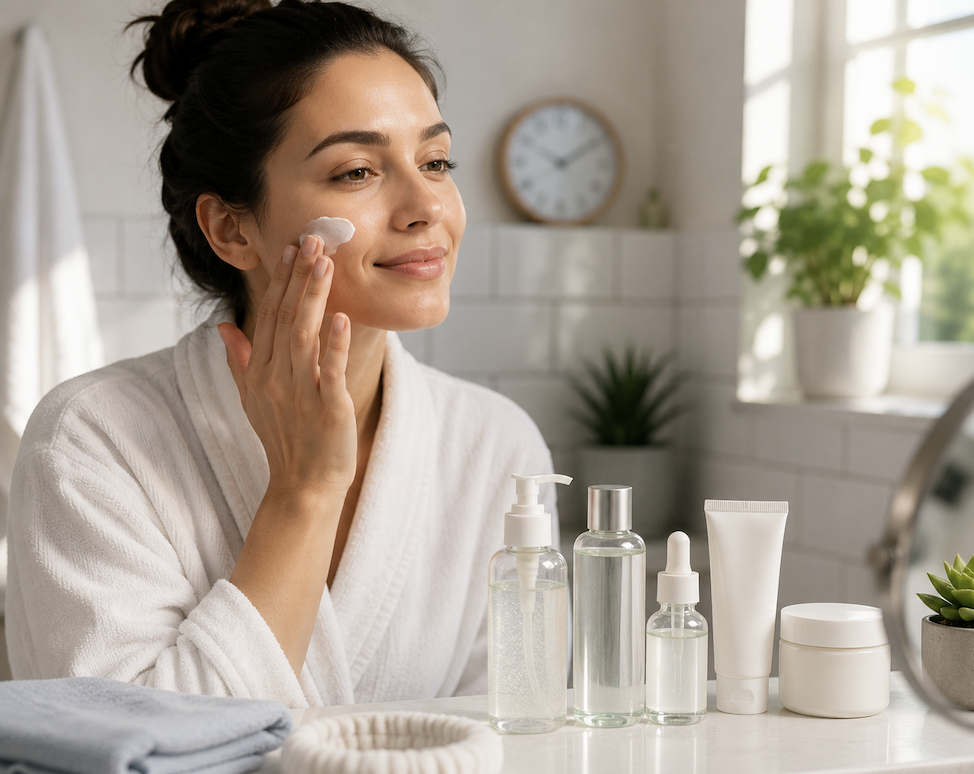
A good morning skincare routine doesn’t need ten products or twenty minutes. It needs a handful of steps done consistently, in the right order, with the one step most people underestimate actually getting the priority it deserves. This guide breaks down a realistic five-step routine that fits into a normal weekday morning.
Why Morning and Night Routines Aren’t the Same
Nighttime skincare focuses on repair, treating and renewing skin while you sleep. Morning skincare has a different job: protecting skin from what it’s about to face during the day, particularly sun exposure and environmental stress. This is why a morning routine can be shorter than a night routine but shouldn’t skip its most important step, which is sunscreen.
Step 1: A Gentle Cleanse (or None at All)
If your skin isn’t oily by morning, a splash of lukewarm water may be enough, you’re not removing makeup or a full day of buildup the way you are at night. If you do cleanse, use a gentle, non-stripping cleanser rather than the same exfoliating or treatment cleanser you might use in the evening. Over-cleansing in the morning is a common cause of dryness and irritation later in the day.
Step 2: A Lightweight Antioxidant Serum (Optional but Useful)
A vitamin C serum, or another antioxidant-based product, is one of the few morning-specific additions worth considering. Antioxidants help offset some of the environmental stress skin is exposed to during the day, and applying them in the morning, rather than at night, is when they’re most useful. This step is optional; skipping it won’t undermine the rest of the routine, but it’s a reasonable place to invest if you’re going to add just one extra product.
Step 3: Moisturizer Suited to Your Skin
A lightweight, non-greasy moisturizer works for most skin types in the morning, since a heavier cream can feel uncomfortable under makeup or throughout a warm day. Dry skin may still need something richer, and that’s fine, the goal is comfortable, hydrated skin, not a specific product texture for its own sake.
Step 4: Sunscreen, The Step That Actually Matters Most
This is the step most people either skip or apply inconsistently, and it’s the one doing the most long-term work. Daily sunscreen use is one of the most well-supported recommendations in skincare for preventing premature aging and reducing skin damage over time, and it matters even on cloudy days or when you’re mostly indoors near windows.
A broad-spectrum sunscreen with at least SPF 30 is a reasonable daily minimum. For a five-minute morning routine, choosing a sunscreen that also functions as your daytime moisturizer (a combined SPF moisturizer) can simplify things without cutting corners on protection.
Step 5: Makeup or Nothing, Your Choice
Whether you wear makeup on top of this routine is entirely optional and doesn’t affect the effectiveness of the skincare steps underneath, as long as you give each product a minute or two to absorb before applying the next layer.
Building the Routine Gradually
If you’re starting from nothing, don’t add every step at once. Begin with moisturizer and sunscreen for the first week or two, then layer in cleansing and a serum once the core habit is established. Routines built gradually tend to stick far better than ones that start elaborate and get abandoned within a month.
Seasonal Adjustments Worth Making
A moisturizer that feels right in summer can feel insufficient in winter, particularly in climates with dry indoor heating. It’s reasonable to switch to a slightly richer moisturizer in colder months and a lighter one in warmer months, rather than using the same product year-round regardless of climate. Sunscreen, on the other hand, shouldn’t change with the seasons, UV exposure remains relevant even in winter and on overcast days.
Layering Products Correctly
As a general rule, apply products from thinnest to thickest consistency: a watery serum before a creamier moisturizer, for example. Applying a heavy product first can prevent a lighter one layered on top from absorbing properly, reducing its effectiveness regardless of how good the product itself is.
Combination Skin: A Special Case
Combination skin, which is oily in the T-zone and drier along the cheeks, often responds best to a slightly customized approach rather than a single product used uniformly. Some people find success applying a lighter, oil-free moisturizer to the forehead and nose while using a richer formula on the cheeks and jawline, effectively treating the face as two zones rather than one. This takes a bit more effort but tends to produce a more even, balanced result than forcing one product to do both jobs.
Patch Testing Before Adding a New Product
Any time you introduce a new product to your morning routine, apply it to a small area, like the inside of your forearm or along the jawline, for a few days before applying it to your whole face. This is especially worth doing for active ingredients like vitamin C serums, since a reaction confined to a small test area is far easier to manage than one spread across your entire face right before you need to leave for work.
Ingredient Pairings to Avoid in the Morning
Certain active ingredients don’t layer well together and can cause irritation if combined carelessly. Vitamin C and certain exfoliating acids, for example, can be too much for skin when used in the same routine, particularly for sensitive skin types. If you’re using a vitamin C serum in the morning, it’s generally best to save stronger exfoliants for your evening routine instead, rather than combining multiple actives in one sitting.
Travel-Friendly Routine Adjustments
When traveling, it’s tempting to skip the routine entirely, but a simplified travel version, just moisturizer and sunscreen in travel-sized containers, takes up minimal space and maintains the habit. Skin often reacts to changes in climate and water quality while traveling, so it’s also a reasonable time to stick with familiar products rather than trying something new, since a new irritation is harder to diagnose away from your normal environment and routine.
Why Consistency Beats Product Switching
A common pattern is switching moisturizers or serums every few weeks in search of faster results, which actually makes it harder to tell what’s working. Skin cell turnover happens on a roughly four-to-six-week cycle, so giving any single product that full window before judging it, rather than switching after a few days of no visible change, gives you a much clearer picture of whether it’s actually suited to your skin.
A Realistic Five-Minute Version
On mornings with genuinely no time, the routine can be trimmed to two non-negotiable steps: moisturizer and sunscreen. Everything else in this guide is beneficial but optional; those two steps are the ones worth protecting even on the busiest days.
Adjusting for Your Skin Type
Oily or acne-prone skin generally does better with a gel-based, oil-free moisturizer and a matte-finish sunscreen, since heavier formulas can contribute to congestion. Dry or sensitive skin benefits from cream-based, fragrance-free products, and a mineral sunscreen (rather than a chemical one) is often gentler for sensitive or reactive skin.
Combination skin, which is oily in some areas and dry in others, can sometimes benefit from applying a lighter moisturizer to the oilier zones (like the forehead and nose) and a slightly richer one to drier areas (like the cheeks), rather than using a single product uniformly across the whole face.
Common Morning Routine Mistakes
Applying sunscreen as the very last step, rather than layering it in the middle of the routine, is a common error, sunscreen generally goes after moisturizer and before makeup, not before moisturizer, since applying it too early can dilute its protective film once other products are layered on top.
Using too little sunscreen is another frequent issue. Most people apply less than half of the amount used in official testing, which meaningfully reduces the actual protection level below what’s printed on the bottle. A generous, even layer across the whole face and neck matters more than the specific brand chosen.
Skipping sunscreen on cloudy or indoor days is also common, but UV exposure isn’t limited to direct, sunny conditions, a large percentage of UV rays still reach skin through cloud cover, and windows don’t block all types of UV radiation.
Conclusion
A morning skincare routine doesn’t need to be elaborate to be effective. Cleansing lightly (or not at all), moisturizing appropriately for your skin type, and applying sunscreen consistently and generously will do more for your skin’s long-term health than a longer routine used inconsistently. If you only have time for two steps, make them moisturizer and sunscreen.
- Read more about Newolt!