
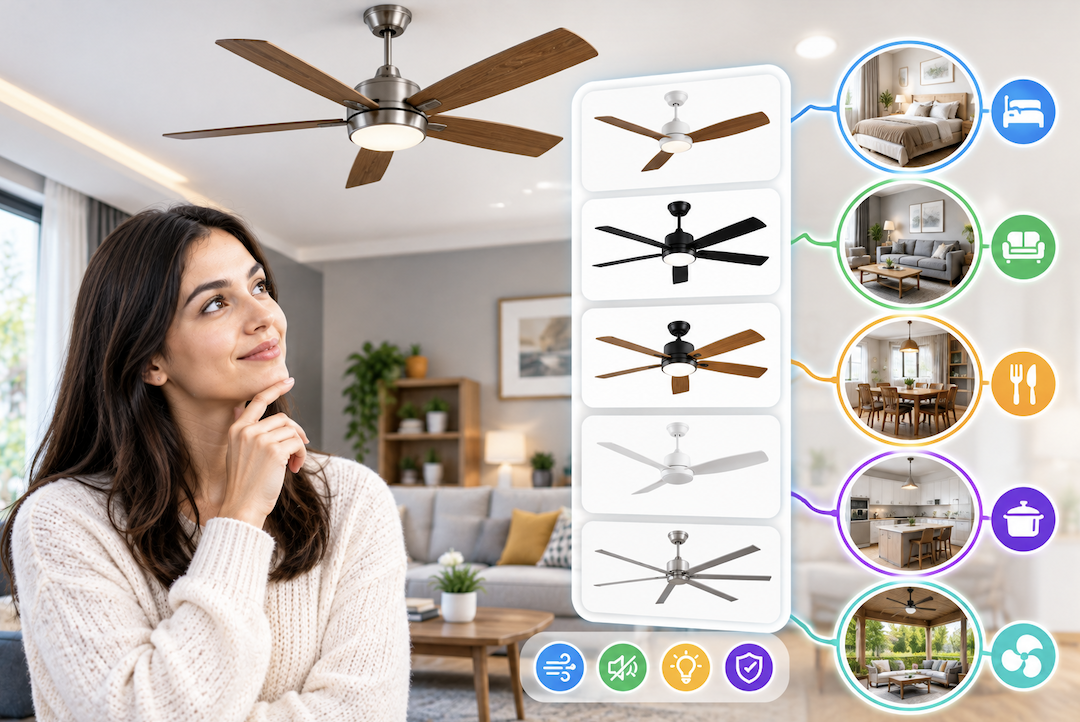
A ceiling fan is one of the more overlooked fixtures in a home, often chosen quickly based on appearance alone, despite the fact that getting the size, airflow, and features right makes a real difference in comfort and energy use year-round. This guide covers the practical factors that actually matter when choosing one for any room.
Why Ceiling Fans Matter Beyond Aesthetics
A properly sized, well-functioning ceiling fan can make a room feel several degrees cooler in summer through the wind-chill effect on skin, allowing a thermostat to be set higher without sacrificing comfort, and reversed in winter, it helps redistribute warm air trapped near the ceiling, discussed briefly in the earlier weatherproofing guide. Both effects translate into energy savings over a full year, making a ceiling fan a functional investment rather than purely a decorative one.
Blade Span Sizing by Room Size
Blade span, the diameter measured across the full sweep of the blades, should be chosen based on room square footage rather than personal preference alone. As a general guideline, rooms under 75 square feet suit a fan with a blade span around 29 to 36 inches, rooms up to 175 square feet suit 36 to 42 inches, rooms up to 350 square feet suit 44 to 50 inches, and larger rooms benefit from fans in the 50 to 60-plus inch range, sometimes requiring two smaller fans rather than one oversized unit for very large or oddly shaped spaces.
Considering Fan Size for Open Floor Plans
For open floor plans spanning kitchen, dining, and living areas as one continuous space, calculating total combined square footage rather than treating it as several smaller separate rooms helps determine whether a single large fan or multiple appropriately sized fans, discussed later in this guide, better suits the space.
Blade Pitch and Its Effect on Airflow
Blade pitch, the angle at which blades are tilted, affects how much air a fan actually moves regardless of blade span or motor speed. A steeper pitch, generally in the 12 to 15-degree range, moves more air per rotation than a shallow pitch, making pitch a meaningful factor to check alongside blade span rather than assuming size alone determines a fan’s cooling effectiveness.
CFM Ratings
CFM, or cubic feet per minute, measures the actual volume of air a fan moves at its highest speed setting, offering a more precise, comparable metric than blade span or pitch alone. Comparing CFM ratings between fans of similar size gives a more objective sense of which model will move more air, rather than relying on size and pitch as indirect proxies for actual performance.
Motor Quality Indicators
A higher-quality motor runs more quietly, wobbles less at higher speeds, and lasts considerably longer than a budget motor prone to humming or vibration over time. Checking a fan’s specific motor size and reading reviews that specifically mention long-term noise and wobble issues, rather than judging purely by initial appearance or price, helps avoid a fan that becomes an annoying background presence within the first year of use.
Number of Blades and Its Actual Impact
Blade count, often marketed heavily, has a smaller practical effect on airflow than blade pitch and motor quality, and fans with fewer, wider blades can move comparable air to fans with more, narrower blades depending on overall design. Prioritizing pitch and CFM ratings, already discussed, over blade count alone avoids being swayed by a specification that matters less than the marketing sometimes implies.
Downrod Length and Ceiling Height
The downrod, connecting the fan to the ceiling mount, needs to be sized appropriately for ceiling height, since blades positioned too close to the ceiling move air less efficiently, while blades positioned too low pose both a safety and comfort issue. A general guideline places the blades roughly 8 to 9 feet above the floor for optimal airflow, meaning a taller ceiling generally requires a longer downrod than the one included by default with many fans, which are often sized for standard 8-foot ceilings.
Considering Sloped or Vaulted Ceilings
For sloped or vaulted ceilings, a fan needs a specifically rated sloped-ceiling mount or adapter to hang level despite the angled ceiling surface, and checking that a chosen fan and mounting hardware explicitly support your ceiling’s specific slope angle avoids a fan that hangs crookedly or, worse, isn’t properly secured for that non-standard ceiling type.
Choosing a Flush Mount for Low Ceilings
For rooms with ceilings lower than roughly 8 feet, a flush or “hugger” mount fan, installed directly against the ceiling without a downrod, avoids the safety concern of blades hanging too low while still providing functional airflow, though flush mount fans generally move somewhat less air than a downrod-mounted fan positioned at the ideal height discussed above.
Reversing Airflow Direction Seasonally
As mentioned in the earlier weatherproofing guide, most ceiling fans include a direction switch allowing counterclockwise rotation in summer, creating a direct downward breeze for cooling, and clockwise rotation in winter at a lower speed, gently pulling warm air down from the ceiling without creating a noticeable draft. Checking that a specific fan includes this reversible feature, rather than assuming it’s universal, ensures this year-round energy benefit is actually available.
Considering Fan Warranty Coverage
Checking a fan’s warranty length, particularly for the motor specifically since that’s the most expensive component to replace if it fails, gives a useful indicator of manufacturer confidence and provides recourse if a defect emerges within the covered period, similar to the warranty considerations discussed throughout earlier appliance and electronics guides.
Noise Considerations for Bedrooms and Quiet Spaces
For bedrooms or home offices where quiet operation matters most, prioritizing a fan specifically reviewed for low noise at typical operating speeds, rather than assuming any fan runs quietly enough, avoids a distracting hum or rattle that becomes particularly noticeable in an otherwise quiet room used for sleep or focused work.
Considering a Fan for a Kitchen Specifically
A kitchen ceiling fan needs to balance airflow with practical placement around existing lighting, cabinetry, and cooking areas, and a fan with a lower profile or flush mount often suits a kitchen’s typically busier ceiling layout better than a fan with a long downrod that might interfere with movement around an island or cooking area.
Integrated Lighting Options
Many ceiling fans include integrated lighting, ranging from a simple single fixture to more elaborate multi-bulb designs, and choosing a light kit with dimmable, warm-toned LED bulbs, similar to the lighting color temperature guidance covered in the earlier outdoor lighting guide, provides flexible, energy-efficient illumination without needing a separate ceiling fixture in the room.
Considering a Fan for a Bedroom Specifically
Beyond noise, a bedroom fan benefits from a remote or smart control accessible from bed, and a light kit with a warm, dimmable setting suited to winding down in the evening, rather than a bright, cool-toned light better suited to task-oriented spaces like a kitchen or home office.
Smart and Remote Control Features
A remote control or smart home-compatible fan, discussed in the context of broader smart home hubs in an earlier guide, adds convenience for adjusting speed and lighting without needing a wall switch or pull chain, particularly useful for fans installed with a downrod long enough that pull chains are out of comfortable reach.
Considering Air Circulation Beyond Comfort
Beyond comfort, good air circulation from a properly functioning ceiling fan also helps reduce humidity buildup and can lower the risk of mold or mildew developing in poorly ventilated rooms, particularly bathrooms or basements discussed in earlier moisture-related home guides, adding a practical health benefit beyond simple temperature comfort.
Damp and Wet Rated Fans for Specific Locations
For covered outdoor patios, screened porches, or bathrooms, a fan specifically rated for damp or wet conditions is essential rather than optional, since a standard indoor-rated fan’s motor and components aren’t designed to handle the humidity or direct moisture exposure these locations involve. Damp-rated fans suit covered, protected outdoor areas, while wet-rated fans are necessary for locations with direct exposure to rain or water spray.
Considering a Fan’s Overall Build Quality Beyond the Motor
Beyond the motor itself, checking the quality of the mounting bracket, blade attachment hardware, and overall housing materials gives a fuller picture of long-term durability, since a fan with an excellent motor but flimsy blade brackets can still develop wobble or rattling issues over time despite the core motor performing well.
Energy Efficiency Ratings
Checking a fan’s efficiency rating, which measures airflow generated per watt of energy consumed, helps compare options beyond just blade span and motor size alone, since two fans of similar size can have meaningfully different energy efficiency depending on motor and blade design quality.
DIY Installation vs Hiring an Electrician
Replacing an existing ceiling fan with a similar model, using the same existing electrical box and wiring, is a reasonable DIY project for many homeowners with basic electrical comfort. Installing a fan where none existed before, requiring new wiring or a new, properly rated electrical box capable of supporting a fan’s weight and movement, is worth hiring a licensed electrician for, both for safety and because standard light fixture boxes aren’t rated for the additional stress a rotating fan places on the mounting point.
Matching Fan Style to Room Decor
Beyond function, ceiling fans are increasingly designed in styles ranging from traditional to modern industrial to minimalist, making it reasonable to prioritize a design that coordinates with existing room decor and fixture finishes, similar to the fixture coordination principle discussed in earlier outdoor lighting and floating shelf guides, once the functional sizing and airflow factors have been addressed.
Considering Blade Material and Finish
Blade material affects both appearance and durability, with wood or wood-composite blades offering a classic look, while ABS plastic or metal blades tend to be more resistant to warping in humid environments. For bathroom, outdoor, or otherwise humid installations, checking blade material specifically alongside the damp or wet rating discussed earlier avoids blades that warp or delaminate prematurely in that specific environment.
Considering Fan Placement Relative to Air Vents
Positioning a ceiling fan too close to an HVAC supply or return vent can create turbulent, inefficient airflow patterns where the fan and the vent effectively work against each other rather than complementing the room’s overall air circulation. Checking existing vent placement before finalizing fan position, where installation flexibility allows, avoids this less obvious but efficiency issue.
Fan Placement Within a Room
Centering a fan within a room generally provides the most even airflow distribution, though for irregularly shaped rooms or rooms with a clearly defined primary seating or sleeping area, positioning the fan to direct airflow toward that main use area, rather than strictly centering it geometrically, often produces more noticeably comfortable results in daily use.
Considering Multiple Fans for Open-Concept Spaces
For large, open-concept living areas, installing two appropriately sized fans rather than one oversized fan often provides more even airflow throughout the space and avoids the visual and physical impracticality of an extremely large single fan that might overwhelm the room proportionally.
Considering a Ceiling Fan’s Resale and Home Value Impact
For homeowners considering resale value, a well-chosen, properly installed ceiling fan in main living areas and bedrooms is generally viewed as a practical, desirable feature by most buyers, similar to how updated lighting fixtures are perceived, while a poorly matched or visibly low-quality fan can occasionally have the opposite effect on a room’s overall impression during a home showing.
Common Ceiling Fan Mistakes
Choosing a fan based purely on appearance without checking blade span against room size is one of the most common mistakes, resulting in a fan that looks appropriate but underperforms functionally for the space. Skipping the seasonal direction reversal entirely, either from not knowing the feature exists or forgetting to use it, is another common oversight that leaves meaningful energy savings unrealized throughout the winter months specifically.
Maintaining a Ceiling Fan Over Time
Periodically cleaning dust from fan blades, which can accumulate surprisingly quickly and both reduce airflow efficiency and become a minor allergen concern, along with checking that mounting screws remain tight over time, similar to the fixture maintenance habits discussed in earlier floating shelf and outdoor lighting guides, keeps a ceiling fan performing well throughout its typical multi-year lifespan.
A Simple Pre-Purchase Checklist
Before finalizing a ceiling fan purchase, confirming blade span matches room size, CFM rating is competitive for that size, the fan includes seasonal direction reversal, and the mounting type suits your specific ceiling height and slope, covers the core functional decisions discussed throughout this guide in one final review before committing to a purchase.
Conclusion
Choosing the right ceiling fan comes down to matching blade span to room size, checking motor quality and noise reviews, and ensuring downrod length positions blades at an effective height for your specific ceiling. Using the seasonal reversal feature and choosing a damp- or wet-rated model for outdoor or bathroom installations rounds out the practical considerations that matter more for year-round comfort and energy savings than style alone.