
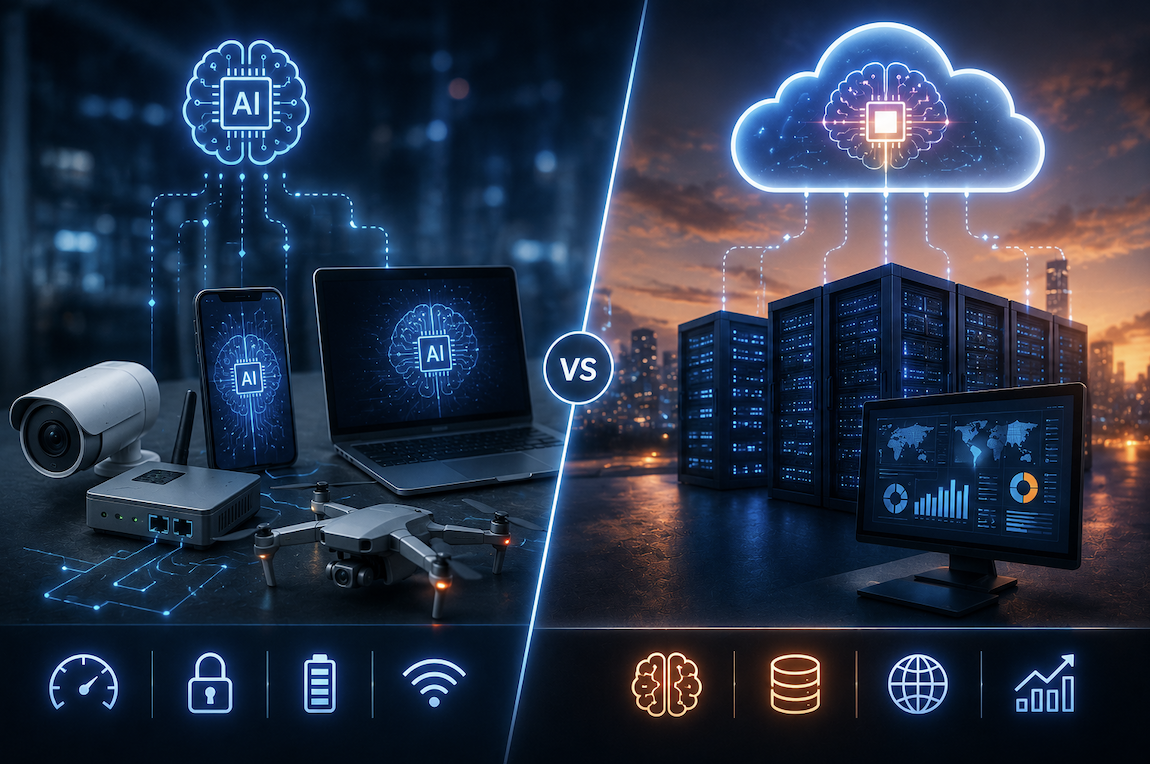
Artificial intelligence has traditionally relied on powerful, centralized cloud servers to handle the heavy computational work involved in processing requests, but a growing category of AI applications now runs directly on local devices instead, a shift called edge AI. Understanding what genuinely distinguishes edge AI from the more familiar cloud-based approach helps explain why this shift matters for both device performance and everyday privacy.
What Edge AI Actually Means
Edge AI refers to running artificial intelligence processing directly on a local device, such as a smartphone, smart camera, or other connected hardware, rather than sending data to a remote cloud server for processing and waiting for a response to travel back. The term “edge” refers to the outer boundary of a network, closer to where data is actually generated, as opposed to the centralized “cloud” servers positioned considerably further away.
This local processing approach represents a genuinely significant shift in how AI applications have traditionally been architected, since much of the AI functionality people have grown accustomed to over the past decade has relied heavily on powerful, centralized cloud infrastructure handling the actual computational heavy lifting behind the scenes.
How Cloud AI Traditionally Works by Comparison
Understanding the traditional cloud AI approach provides useful context for appreciating what genuinely changes when processing moves to the edge instead.
- Your device captures data, such as a photo or spoken command, and sends it to a remote server
- The cloud server, equipped with considerable computational power, processes this data
- The result gets sent back to your device over the internet, completing the round trip
- This approach requires a reliable internet connection and introduces some inherent transmission delay
This round trip travel time, however brief it might feel, genuinely adds up, particularly for applications requiring near-instantaneous response, which is precisely the kind of limitation that has driven considerable interest in processing data locally on the device instead, whenever the device itself has sufficient computational capability to actually handle the task.
Why Edge AI Genuinely Reduces Latency
Understanding why eliminating this round trip to a distant server matters so significantly for certain applications helps explain edge AI’s growing appeal across numerous device categories.
- Processing data locally eliminates the transmission time needed to reach a remote server and back
- This reduced delay matters considerably for applications requiring near-instantaneous response
- Real-time applications, like certain camera features or voice recognition, benefit significantly from this speed
- Even a fraction of a second delay can meaningfully affect the user experience for genuinely time-sensitive tasks
This latency reduction becomes particularly significant for applications where even a brief delay noticeably affects usability, such as camera features that need to adjust settings instantly based on what they detect, or voice assistants that feel considerably more natural when responses arrive without a perceptible pause.
How Edge AI Genuinely Improves Privacy
Beyond speed, edge AI offers a genuinely significant privacy advantage, since data processed locally does not need to leave your device and travel to an external server at all.
- Data processed on-device never needs to be transmitted to an external server for analysis
- This reduces the amount of potentially sensitive information traveling across networks
- Users maintain considerably more control over their own data when processing stays local
- This privacy benefit has become an increasingly significant selling point for various consumer devices
This privacy advantage genuinely matters for applications involving sensitive personal data, such as facial recognition for unlocking a device, since keeping this processing entirely local means your biometric data never needs to travel across the internet or reside on a company’s remote servers at all.
The Genuine Trade-Offs Edge AI Involves
Despite its genuine advantages, edge AI is not automatically superior to cloud AI in every situation, and understanding these trade-offs helps clarify why both approaches continue coexisting rather than one entirely replacing the other.
- Local devices generally have considerably less computational power than large, centralized cloud servers
- This means edge AI models are often somewhat simpler or less sophisticated than their cloud-based counterparts
- Battery life on portable devices can be genuinely affected by the additional processing demands
- Certain genuinely complex AI tasks still require the substantial computational power only cloud servers can provide
This computational limitation deserves particular emphasis, since it explains why edge AI tends to handle more focused, specific tasks efficiently, while genuinely complex, open-ended AI applications often still rely on cloud processing to access the substantial computational resources these more demanding tasks require.
Common Everyday Applications of Edge AI
- Smartphone camera features that adjust settings and apply effects instantly as you compose a shot
- Voice assistants that can process basic commands without needing an active internet connection
- Smart home security cameras that detect motion or recognize faces without transmitting constant video streams
- Wearable fitness devices that analyze health data locally rather than continuously streaming it elsewhere
- Industrial equipment that needs to make split-second safety decisions without network dependency
Why Many Modern Applications Actually Combine Both Approaches
Rather than choosing exclusively between edge and cloud processing, many genuinely sophisticated modern applications combine both approaches strategically, handling time-sensitive or privacy-sensitive tasks locally while relegating more complex processing to the cloud when appropriate.
- Simple, time-sensitive tasks get handled locally on the device for speed and privacy
- More complex analysis that requires substantial computational power gets sent to the cloud
- This hybrid approach balances the genuine strengths of both processing locations
- Understanding this combination helps explain why many devices use both edge and cloud AI simultaneously
How Chip Manufacturers Have Adapted Hardware Specifically for Edge AI
Understanding the genuine hardware innovation happening behind the scenes helps explain how edge AI has become increasingly capable despite the inherent computational limitations of local devices compared to massive cloud data centers.
Major chip manufacturers have developed specialized processing components specifically designed to handle AI calculations efficiently within the power and size constraints of consumer devices, a genuinely significant departure from simply using general-purpose processors for these specialized tasks. These dedicated AI processing components, often integrated directly into smartphone and other consumer device chips, can handle many AI tasks considerably more efficiently than a general-purpose processor would manage, allowing increasingly sophisticated edge AI capabilities within devices that still need to remain compact, energy-efficient, and reasonably priced for everyday consumer use.
- Specialized AI processing components are increasingly built directly into consumer device chips
- These dedicated components handle AI tasks more efficiently than general-purpose processors alone
- This hardware innovation has allowed edge AI capabilities to expand considerably within existing device constraints
- Understanding this trend helps explain why edge AI continues to become more capable with each device generation
Final Thoughts
Edge AI represents a genuinely significant shift toward processing artificial intelligence tasks locally on devices rather than relying exclusively on distant cloud servers, offering meaningful improvements in speed and privacy for many everyday applications. Understanding both its genuine advantages and its real computational limitations helps explain why this approach has become increasingly prevalent across consumer devices, often working alongside cloud AI rather than replacing it entirely.
- Read more about Newolt
Frequently Asked Questions
1. Does edge AI work without an internet connection at all?
Many edge AI applications can genuinely function without an active internet connection, since the processing happens entirely on the local device, though some applications may still require connectivity for certain features or periodic updates to their underlying models.
2. Is edge AI less accurate than cloud-based AI?
This depends on the specific application, since edge AI models are often somewhat simplified compared to their cloud counterparts due to computational limitations, though for many focused, specific tasks, the accuracy difference is genuinely minimal or unnoticeable to most users.
3. Does using edge AI drain my device’s battery faster?
Processing AI tasks locally does require genuine computational resources that can affect battery life, though manufacturers have made considerable efficiency improvements, and many edge AI applications are specifically optimized to minimize this impact.
4. Will edge AI eventually replace cloud AI entirely?
This seems unlikely, since certain complex AI applications will likely continue requiring the substantial computational resources only cloud infrastructure can provide, meaning both approaches will likely continue coexisting, often combined within the same device or application.
5. How can I tell if a specific device feature is using edge AI or cloud AI?
This is not always obvious to everyday users, though features that continue working without an internet connection are generally using edge AI, while features that stop functioning or become noticeably slower without connectivity likely rely on cloud processing.