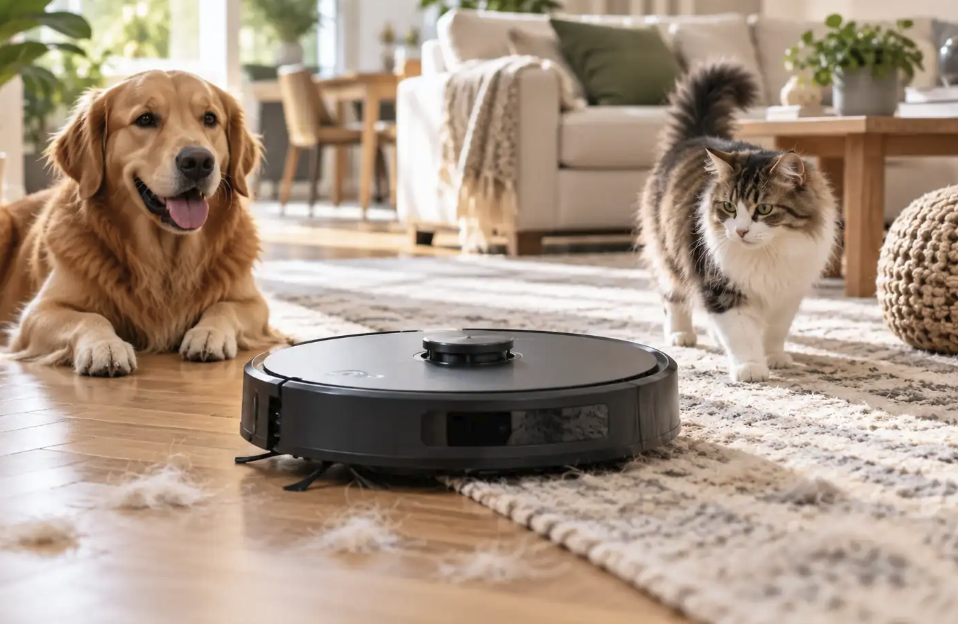
Pet owners face a particular cleaning challenge: fur that embeds itself in carpet fibers, clings to furniture legs, and reappears within days of the last cleaning session.
A robot vacuum built for this job can make a real difference in day-to-day upkeep, but not every model handles pet hair and thick carpet equally well. Suction ratings, brush design, and navigation software all play a role in whether a robot leaves a room spotless or pushes hair into corners.
This guide breaks down what matters most when shopping for a robot vacuum in a pet-heavy, carpet-heavy home.
Suction Power and Brush Design for Pet Hair
Suction strength is usually the first spec shoppers look at, and it matters, but brush design often determines whether that suction gets put to good use on pet hair specifically. Bristle brushes can be excellent at agitating carpet fibers to lift embedded hair, but they are also notorious for hair wrapping tightly around the bristles, which can slow the brush or require frequent manual removal.
Rubber or silicone brush rolls, sometimes marketed as tangle-free or anti-hair-wrap designs, tend to perform better in pet households because hair is less likely to wind around the roller itself. Many current models combine a rubber brush with small embedded fins or a secondary bristle strip to balance agitation with reduced tangling.
When comparing suction specifications between models, keep these points in mind:
- Pascal ratings versus airwatts: Manufacturers use different units to describe suction, so compare within the same measurement system rather than across brands using different scales.
- Carpet boost modes: Many robots automatically increase suction when a carpet sensor is triggered, which matters more for pet hair embedded deep in pile than raw suction numbers alone.
- Dual brush systems: Models with both a main roller and a side brush tend to pull hair from edges and corners more effectively than single-brush designs.
- Hair-cutting mechanisms: Some premium models include a built-in comb or cutting blade that slices tangled hair during operation, reducing manual maintenance quite a bit over a typical ownership period.
- Bin capacity: Pet hair fills a dustbin faster than ordinary dust, so a larger bin or a self-emptying base reduces how often you need to intervene.
A robot with modest suction but excellent tangle resistance and a smart carpet boost can often outperform a higher-suction model whose brush clogs within a few cleaning cycles.
Reading owner reviews that specifically mention pet hair, rather than relying only on a manufacturer’s marketing copy, tends to surface the real-world performance differences between models more reliably. Shoppers with long-haired dogs or cats often report different experiences than shoppers with short-haired breeds, since hair length changes how easily it wraps around a roller versus simply getting lifted and collected in the bin. Checking reviews from owners with similar pets and similar flooring can narrow the field quite a bit before making a final decision.
Navigation and Mapping Technology
Older robot vacuums bumped around rooms somewhat randomly, covering some areas multiple times and missing others entirely. Current mapping-capable robots use cameras or laser-based sensors to build a structured map of a home, then clean in efficient rows rather than random patterns. For pet households, this matters because efficient coverage means less time between passes over high-shedding zones like a dog bed or a favorite carpet spot.
Mapping also enables room-specific scheduling and no-go zones, which are useful for keeping a robot away from a litter box, a food and water bowl area, or a pet’s crate. Some models let you draw virtual walls directly in a companion app, while others rely on small physical barrier accessories placed on the floor.
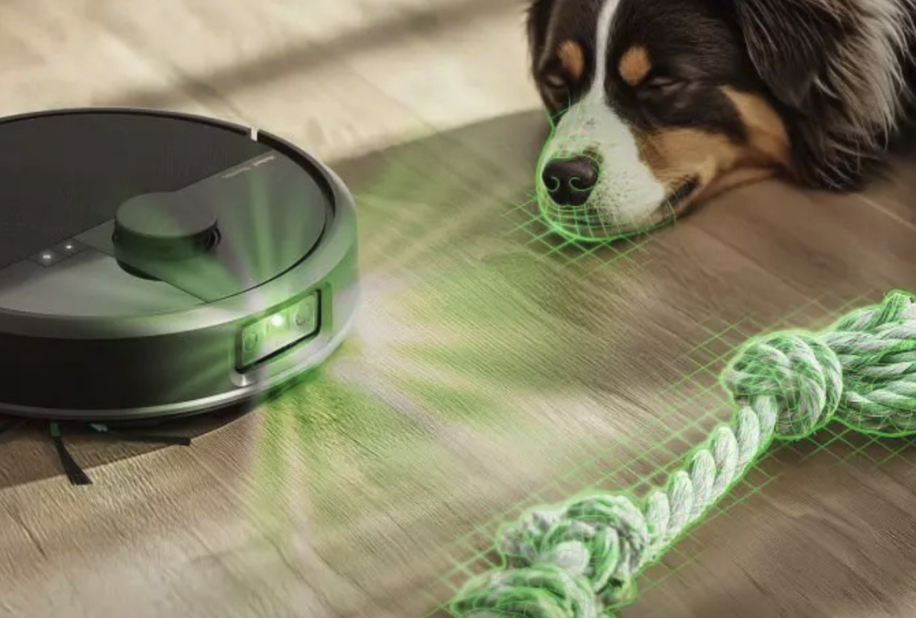
Obstacle detection is another area where pet owners notice real differences between models. Cheaper robots may get stuck on pet toys, cords, or stray socks, while more advanced sensor systems can identify and route around small objects without becoming trapped. Given that most pet homes have a steady stream of chew toys and loose items on the floor, this capability can noticeably reduce how often a robot needs rescuing mid-cycle.
Mapping technology also opens up multi-floor support in many current models, where the robot stores separate maps for each level of a home and switches between them automatically or on command. For households with pets that spend time on more than one floor, shedding evenly throughout the home, this feature keeps the cleaning schedule consistent across every level rather than requiring a fresh map to be built each time the robot is carried upstairs or downstairs.
Comparing Budget and Premium Models
Price differences between robot vacuum tiers often come down to a handful of features that matter disproportionately in pet-heavy homes, even if they seem minor on a spec sheet.
- Self-emptying bases: Premium models often include a base station that empties the robot’s bin into a larger bag, which is especially valuable given how quickly pet hair fills a small onboard bin.
- Mopping attachments: Combination vacuum-mop robots can handle hard floors tracked with muddy paw prints, though most lift the mop pad automatically when crossing onto carpet.
- App sophistication: Higher-tier models typically offer more detailed scheduling, zone cleaning, and maintenance reminders through their companion apps, along with cleaning history reports that help track coverage over time.
- Battery and runtime: Larger homes with more square footage to cover benefit from models with longer runtime per charge and faster recharge cycles, which matters most for sprawling single-level homes where the robot travels farther between rooms before returning to dock.
- Noise levels: Pets can be sensitive to vacuum noise, and quieter models are less likely to stress animals that are home alone during a cleaning cycle, which is worth checking carefully for households with anxious cats or dogs.
Budget models can still be a reasonable choice for a small apartment with light shedding, but larger homes with multiple pets and extensive carpeting tend to see a faster return on investment from a mid-tier or premium model with better brush and navigation technology.
It is worth pricing out the ongoing cost of consumables alongside the upfront purchase price, since replacement filters, brush rolls, and self-emptying bags add to the total cost of ownership over several years. A cheaper robot with expensive, hard-to-find replacement parts can end up costing more over its lifetime than a pricier model with widely available, affordable accessories, so checking part availability and pricing before purchase rounds out a fuller cost comparison between tiers.
Maintenance Routines That Extend Lifespan
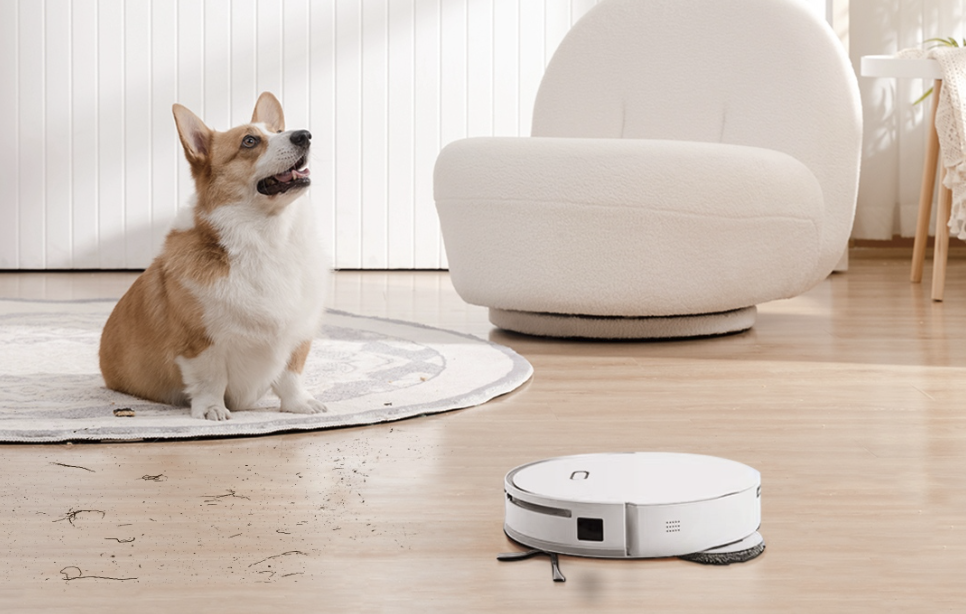
A robot vacuum used daily in a pet household needs more frequent attention than one used occasionally in a pet-free home. Skipping maintenance tends to show up quickly as reduced suction, tangled brushes, and eventually a robot that stalls mid-cycle.
A simple weekly routine makes a large difference over the life of the machine:
- Empty the bin after every cycle or two: Letting pet hair compact inside the bin reduces suction and can clog the inlet.
- Remove hair from the brush roll: Use scissors or a dedicated cleaning tool to cut away wound hair before it reaches the bearings.
- Clean the sensors: Dust and hair can coat navigation sensors, leading to erratic movement or missed obstacles.
- Check and wash filters: Most models use washable or replaceable filters that need regular attention to maintain suction performance.
- Inspect wheels and casters: Hair often wraps around caster wheels, which can eventually cause the robot to drag or stop moving smoently in one direction.
Replacement parts like filters, brush rolls, and side brushes typically wear out faster in pet households than in average homes, so budgeting for periodic part replacement is a realistic part of ownership cost.
Setting a recurring reminder, whether a note on a calendar or an alert through the robot’s companion app, helps keep maintenance consistent rather than reactive. Many owners only think to clean the brush roll once suction has already noticeably dropped, at which point hair may have wound tightly enough around bearings to cause premature wear. Addressing maintenance on a fixed schedule, rather than waiting for a visible problem, tends to extend the working life of the machine quite a bit.
Preparing Your Home for Automated Cleaning
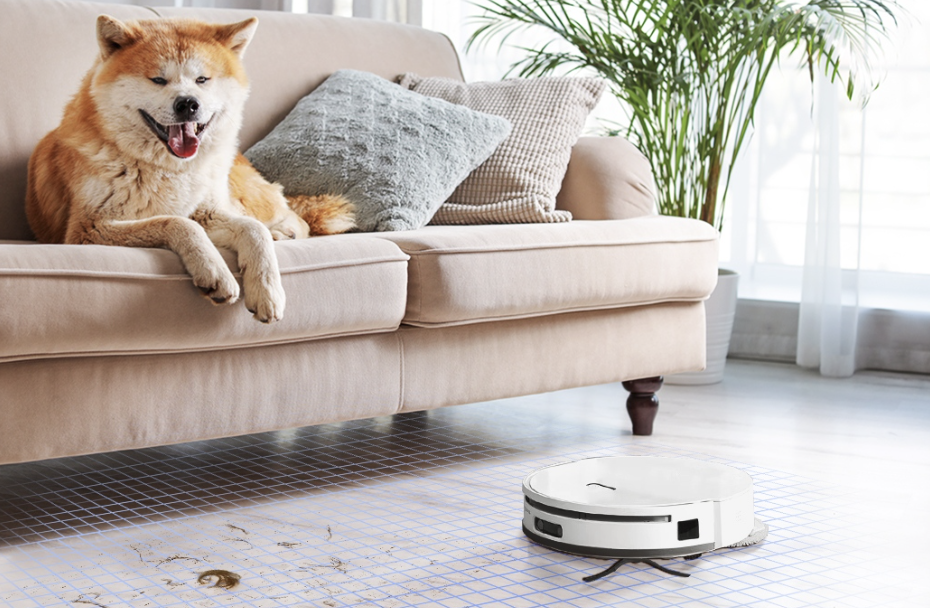
Robots perform best in homes set up to accommodate them, and a few adjustments before the first cleaning session can prevent frustration later. Clearing loose cords, small toys, and low-hanging fabric like tablecloths reduces the chance of the robot becoming tangled or stuck.
Door thresholds and transitions between hard flooring and carpet can also trip up some models, especially those with smaller wheels. Testing a robot in each room individually before setting a full-home schedule helps identify spots where it struggles, so you can adjust virtual boundaries or physically modify the space.
Rugs with long fringe or tassels deserve special attention, since fringe can wrap around a brush roll much like pet hair, sometimes jamming the motor entirely. Tucking fringe under the rug itself, or setting a no-go zone along the rug’s edge, prevents this specific and surprisingly common snag point. Similarly, pet water bowls placed directly on hard flooring can tip over if a robot bumps into them at the wrong angle, so placing bowls on a small raised mat or within a marked no-go zone avoids an unpleasant mid-cycle spill.
Pet behavior matters too. Some pets ignore a robot vacuum entirely, while others bark, chase, or hide from it. Introducing a new robot gradually, running it for short sessions while pets are present, tends to produce calmer long-term coexistence than letting it run a full cycle unsupervised on day one.
Lighting and furniture layout can also affect how well a robot performs in a pet household. Dark-colored rugs or very reflective flooring can occasionally confuse camera-based navigation systems, and furniture with thin, low-hanging legs can trap a robot that misjudges clearance. Walking through each room with the robot’s specific sensor type in mind, and adjusting furniture placement or adding small felt pads under furniture legs where needed, helps the mapping process go smoothly from the very first cleaning session.
A short pre-cleaning checklist can make the first few weeks noticeably smoother:
- Pick up small toys and chews: Loose items are the most common cause of a robot getting stuck mid-cycle.
- Secure loose cords and cables: Tuck or bundle anything hanging near the floor that a brush roll could catch.
- Tuck in rug fringe: Long tassels can wind around a brush roll much like pet hair.
- Set no-go zones around food and water bowls: Prevents accidental spills from a bumped bowl.
- Note problem thresholds: Mark any door transitions where the robot has struggled so you can adjust settings or add a ramp.
Battery Life and Charging Habits
Runtime varies widely between models, generally ranging from about sixty to over one hundred and twenty minutes per charge, with higher suction settings draining the battery faster than standard eco modes. Homes with extensive carpeting, which typically require higher suction to lift embedded hair, tend to see shorter runtimes than homes with mostly hard flooring, since the motor works harder to maintain suction across thicker pile and the carpet boost feature draws noticeably more power than standard cleaning on bare floors.
Most robots automatically return to their charging dock when the battery runs low and resume cleaning from where they left off once recharged, which makes runtime less of a dealbreaker than it might initially seem. Still, for larger homes, checking the stated runtime against your home’s square footage before purchasing helps avoid a robot that needs multiple charging breaks to finish a single cleaning session.
Battery longevity over years of use is another consideration. Like most rechargeable electronics, robot vacuum batteries gradually lose capacity, and replacement batteries are available for many models at a fraction of the cost of a new unit, which can extend the useful life of an otherwise well-functioning robot by several years without needing a full replacement purchase.
Charging habits also matter for preserving battery health over the long run. Leaving a robot permanently docked is generally fine for most current battery technology, since onboard charging circuits are designed to stop drawing power once the battery reaches full charge, but keeping the charging dock in a stable, debris-free location ensures the robot reliably finds and connects to it after each cleaning cycle without wasted time wandering in search of a connection.
Final Thoughts
Choosing a robot vacuum for a pet-heavy, carpet-heavy home comes down to a few specific priorities: tangle-resistant brush design, strong carpet-boost suction, dependable navigation, and a maintenance routine you will keep up with in practice.
The most expensive model on the shelf is not automatically the right fit, and a thoughtfully chosen mid-tier robot with the right brush design can outperform a premium unit poorly suited to your flooring.
Matching the robot to your home’s specific layout, carpet type, and pet behavior produces the best long-term results, and taking the time to prepare the space, set sensible no-go zones, and commit to a simple weekly maintenance habit will do more for long-term satisfaction than any single spec on a sales page.
A little upfront effort in choosing and setting up the right model pays off in cleaner floors and far less manual cleanup down the road.
Read more about Newolt
Frequently Asked Questions
Do robot vacuums really work on thick carpet?
Many current models handle medium to thick carpet reasonably well, especially those with automatic carpet detection that increases suction power when transitioning from hard flooring. Very thick or high-pile carpet can still be challenging, as some robots have limited clearance underneath and may struggle to climb onto deep pile without stalling. Checking a model’s specified maximum carpet pile height before buying, and comparing it against your own thickest rugs, helps avoid a mismatch that leaves certain rooms perpetually skipped during automated cleaning sessions.
How often should I run a robot vacuum in a home with pets?
Daily runs work well for most pet households, since frequent, lighter cleaning sessions prevent hair from accumulating to the point where it becomes embedded in carpet fibers. Running a robot daily rather than weekly also means less hair builds up in the bin per session, reducing how often a bag or bin needs changing, and it generally produces a cleaner-feeling home overall since hair never has the chance to settle deep into carpet fibers between cleaning sessions.
Can a robot vacuum replace a traditional upright vacuum entirely?
For many pet owners, a robot handles daily maintenance cleaning effectively, but a traditional upright or canister vacuum still earns its place for deep cleaning sessions, stairs, upholstery, and edges that robots cannot fully reach. Most pet households find the combination of both tools more effective than relying on either alone, treating the robot as a daily maintenance layer and the upright vacuum as a deeper, less frequent deep-cleaning pass.
Will a robot vacuum scare my pets?
Reactions vary substantially by animal and personality. Many pets adjust within a week or two of exposure, especially when the robot is introduced gradually in short sessions. Choosing a quieter model and allowing pets to investigate the stationary robot before it starts moving can ease the transition, and running the first few sessions at a lower suction and speed setting, where the option exists, can make the initial experience less startling for a nervous animal.
Are expensive robot vacuums worth it for a small apartment?
Smaller spaces with light shedding and mostly hard flooring often do fine with a mid-range model, since many premium features like self-emptying bases and advanced mapping matter more in larger, carpet-heavy homes. A smaller budget model can be a sound choice as long as it has reasonable tangle resistance for pet hair, and the money saved compared to a flagship model can instead go toward a better upright vacuum for occasional deep cleaning.
How do I stop my robot vacuum from getting stuck on pet toys?
Clearing the floor of loose toys, cords, and fabric before each cleaning session remains the most reliable fix, since even advanced obstacle detection can struggle with irregularly shaped or soft objects. Setting up virtual no-go zones in areas where toys tend to accumulate, such as near a pet bed, can also reduce interruptions, and training pets to associate cleaning time with putting toys away in a basket can turn the robot’s schedule into a helpful daily tidying cue for the whole household.