
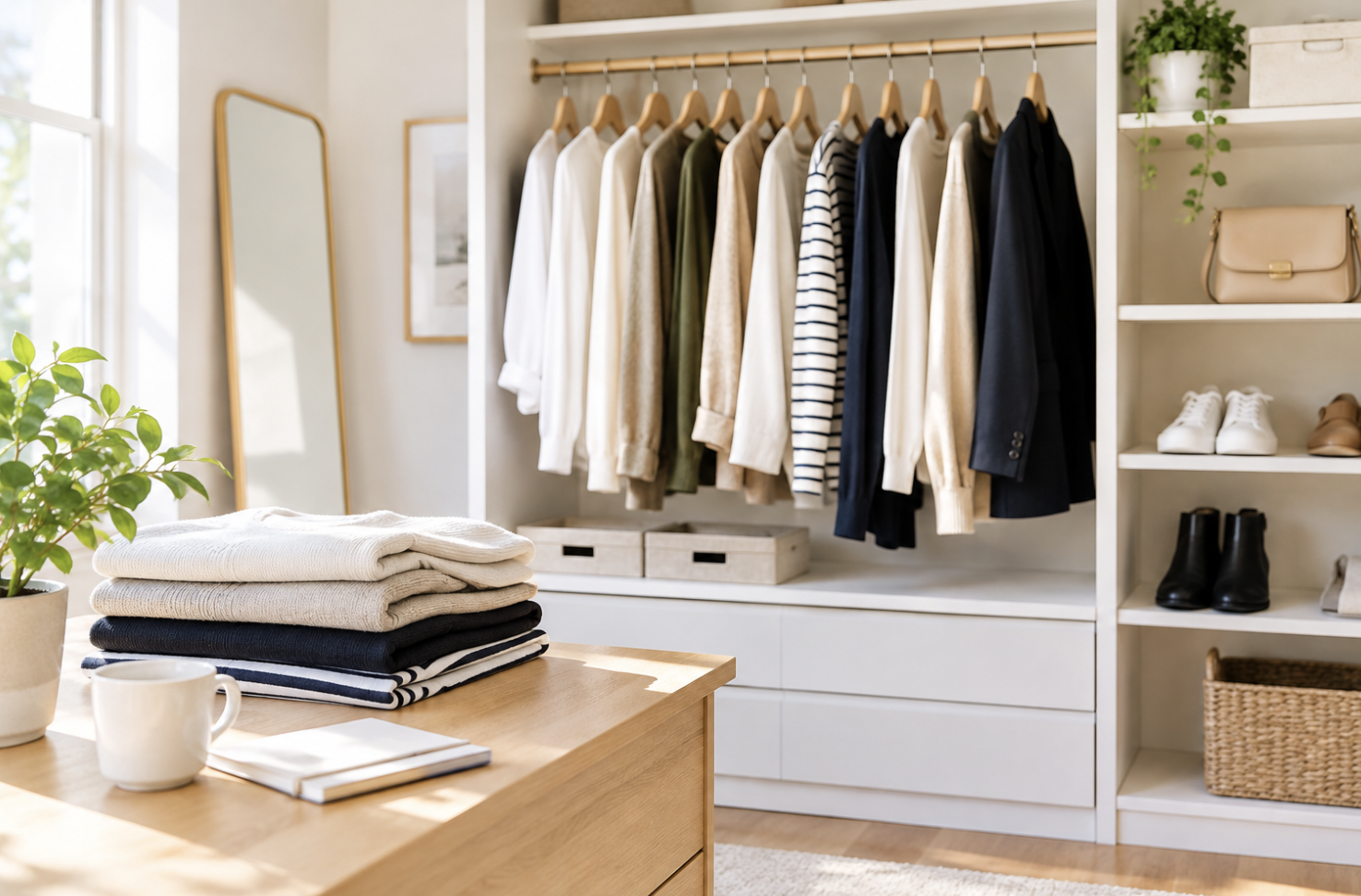
Maya used to spend fifteen minutes every morning standing in front of a closet stuffed with clothes, insisting she had “nothing to wear.” The closet wasn’t empty, it was the opposite problem. Too many half-worn options, too many impulse purchases that never quite matched anything else she owned, too many decisions to make before 8 a.m. Six months into building a capsule wardrobe, that same closet holds roughly a third of what it used to, and getting dressed takes under five minutes.
What a Capsule Wardrobe Actually Is
A capsule wardrobe is a deliberately limited collection of clothing, typically somewhere between thirty and fifty pieces, chosen because each item works with multiple others to create a wide range of outfits. The concept isn’t about owning as little as possible for its own sake, it’s about eliminating the excess that creates decision fatigue and closet clutter without actually expanding what you can wear. A well-built capsule often produces more usable outfit combinations than a much larger, less coordinated closet ever did.
Why Fewer Options Often Means Getting Dressed Faster
Decision fatigue is a well-documented psychological phenomenon where the quality of decisions declines after making too many choices in succession, and a stuffed closet is a decision fatigue machine before the day has even started.
- Fewer, better-coordinated pieces reduce the number of combinations to mentally sort through
- Items chosen for versatility eliminate the “does this even go with anything” hesitation
- A smaller closet makes it easier to see everything available at a glance
- Reduced choice paradoxically increases satisfaction with what gets worn
This isn’t just a tidiness argument, the mental cost of navigating a cluttered, uncoordinated closet every single morning adds up in ways that are easy to underestimate until it’s gone.
Choosing a Color Palette That Actually Works Together
The foundation of a functional capsule wardrobe is a limited, coordinated color palette rather than a random assortment of favorite colors. Building around two or three neutral base colors, such as navy, gray, and black, or a warmer palette of camel, cream, and brown, creates a wardrobe where nearly every top pairs with nearly every bottom.
A small number of accent colors layered on top of that neutral base adds visual variety without breaking the coordination. Skipping this step is the most common reason a capsule wardrobe attempt fails: without a shared color logic, even well-made individual pieces end up sitting unworn because nothing else in the closet matches them.
Identifying the Core Categories Every Capsule Needs
A functional capsule wardrobe typically draws from a handful of essential categories, proportioned to actual lifestyle needs rather than an arbitrary formula.
- Bottoms in versatile cuts and neutral colors that pair with multiple tops
- Tops ranging from basic layering pieces to slightly more distinctive statement items
- One or two outerwear pieces suited to the local climate and seasonal range
- Shoes covering the main use cases, everyday wear, more formal occasions, and activity-specific needs
- A small number of accessories that can shift an outfit’s formality or mood
The exact ratio depends heavily on someone’s actual daily life. A wardrobe built for a desk job with occasional evening plans looks very different from one built around a more physically active or client-facing role, and copying someone else’s exact capsule without adjusting for lifestyle rarely produces good results.
Auditing an Existing Closet Before Buying Anything New
Building a capsule wardrobe starts with subtraction, not addition. Sorting through an existing closet and separating items into categories, worn regularly, rarely worn but loved, and never worn, reveals which pieces are actually earning their space. Items that haven’t been worn in a full year, excluding seasonal or occasion-specific pieces, are strong candidates for donation or resale.
This audit process often reveals that a workable capsule already exists somewhere inside an overstuffed closet, needing far fewer new purchases than expected to complete.
Investing in Quality Over Quantity for Frequently Worn Pieces
A smaller wardrobe changes the math on quality versus price in a meaningful way. Items worn several times a week justify a higher price point if that price buys better fabric, construction, and longevity, since the cost per wear ends up lower than a cheaper item replaced every season.
This doesn’t mean every piece needs a premium price tag, it means allocating a limited budget toward the items getting the most actual use, rather than spreading it evenly across everything including pieces worn only occasionally.
Adapting a Capsule Wardrobe Across Seasons
A single, unchanging capsule rarely works well across drastically different seasons, particularly in climates with temperature swings. A more sustainable approach maintains a core set of year-round basics while rotating a smaller set of seasonal pieces in and out every few months.
Storing off-season items rather than donating them entirely keeps the overall wardrobe manageable without requiring a full rebuild twice a year. This seasonal rotation also creates a natural, built-in opportunity to reassess which pieces are still earning their place.
Avoiding the Common Trap of Over-Purchasing “Just in Case” Items
One of the most common ways a capsule wardrobe quietly expands back into clutter is the “just in case” purchase, an item bought for a hypothetical future occasion that may never actually arrive. A dress bought for an event that gets canceled, shoes bought for a hiking trip that never happens, a jacket bought because it was on sale rather than because it filled an actual gap.
Each individual purchase feels reasonable in the moment, but collectively they’re how a carefully edited thirty-piece wardrobe creeps back toward eighty pieces within a year. Committing to a rule, such as removing one item for every new item added, helps keep the collection intentional over time.
Shopping Strategically Once the Capsule Is Established
Once an initial capsule wardrobe is built and functioning well, the shopping habits that follow determine whether it stays coordinated or gradually drifts back toward clutter. Strategic shopping for an established capsule means identifying specific, deliberate gaps rather than browsing for whatever looks appealing in the moment.
A functioning capsule with thirty-five pieces might need one more versatile top or a better pair of shoes for a specific use case, and shopping with that specific gap in mind produces a far more useful purchase than open-ended browsing ever does.
- Keeping a running list of gaps noticed during actual daily wear, rather than shopping reactively
- Trying new pieces against several existing wardrobe items before purchasing, not just the one outfit imagined in-store
- Setting a seasonal shopping window rather than buying pieces whenever they happen to be seen
- Prioritizing repairs and alterations on existing pieces before assuming a replacement is necessary
This more deliberate approach to shopping tends to produce a wardrobe that keeps improving in quality and coordination over time, rather than one that grows in raw quantity without becoming more functional. It also tends to reduce overall spending, somewhat counterintuitively, since fewer impulsive purchases usually means more budget available for the pieces that are needed and likely to be worn for years.
How a Capsule Wardrobe Changes Your Relationship With Shopping
Beyond the practical closet-space benefits, many people who commit to a capsule wardrobe describe a broader shift in how they relate to shopping and clothing generally. Removing the daily decision fatigue of an overstuffed closet often reduces the emotional pull toward shopping as a form of entertainment or stress relief, since the underlying problem a new purchase used to seem to solve, not having anything to wear, simply doesn’t exist within a well-built capsule.
Purchases become more occasional and more considered, driven by an identified need rather than a passing impulse or a sale notification. This shift doesn’t happen automatically or overnight, and it’s worth being honest that old shopping habits can creep back in without ongoing attention, particularly during high-stress periods or major sales events specifically designed to trigger impulse purchases.
Building small habits, a mandatory waiting period before any non-essential purchase, or a rule requiring an old item to leave the closet for every new one added, helps maintain the discipline a capsule wardrobe depends on long after the initial closet cleanout has faded from memory.
Adapting a Capsule Wardrobe for Different Climates
A capsule wardrobe built for a temperate climate with mild seasonal shifts looks very different from one built for a region with extreme heat, cold, or significant humidity, and applying a generic capsule formula without adjusting for actual climate is a common source of frustration. Hot, humid climates generally favor a capsule built around breathable natural fibers, lighter layering, and a narrower temperature range to plan for, while cold climates require more deliberate investment in outerwear and layering pieces that can dominate a capsule’s budget and closet space if not planned for carefully.
- Hot climates benefit from a higher proportion of breathable fabrics like cotton, linen, and lightweight blends
- Cold climates require strategic investment in a smaller number of higher-quality outerwear pieces
- Layering-friendly pieces matter more in climates with significant temperature swings between morning and afternoon
- Humidity affects fabric choice meaningfully, since some materials handle moisture and wrinkling far better than others
Researching or simply observing what experienced local residents wear, rather than following generic capsule wardrobe advice designed for a different climate entirely, produces a far more functional wardrobe suited to the specific demands of wherever someone actually lives.
Packing and Travel Considerations for a Capsule Wardrobe Lifestyle
One underappreciated benefit of a well-built capsule wardrobe becomes obvious the first time its owner packs for a trip. Because every piece in a capsule wardrobe is already chosen for coordination and versatility, packing for travel becomes dramatically simpler than selecting from a much larger, less coordinated closet.
A capsule wardrobe traveler can often build a full week of varied outfits from a small suitcase, since the same coordination logic that works at home applies directly to a smaller, portable version of the same wardrobe.
- Neutral, coordinated pieces from an existing capsule translate directly into an efficient travel wardrobe
- Fewer, more versatile pieces reduce luggage weight and the temptation to overpack for hypothetical scenarios
- A travel-specific mini capsule, chosen from the larger wardrobe, works well for trips of varying length and climate
- Layering pieces already proven to coordinate at home simplify adapting to unfamiliar travel climates
This travel benefit tends to reinforce the broader capsule wardrobe philosophy for people who experience it directly: if five carefully chosen pieces can produce a full week of outfits while traveling, the same logic applied at home explains why a much larger, uncoordinated closet was never actually necessary in the first place.
Fabric Care Requirements Worth Checking Before Building a Capsule
A capsule wardrobe’s practicality depends heavily on how easy the included pieces are to actually maintain, and this consideration gets overlooked surprisingly often in favor of focusing purely on style and coordination. A wardrobe built around pieces requiring frequent dry cleaning or delicate hand-washing creates ongoing time and cost burdens that undermine the simplicity a capsule wardrobe is supposed to provide in the first place.
- Machine-washable fabrics reduce both the cost and time burden of maintaining a smaller, more frequently worn wardrobe
- Delicate or dry-clean-only pieces should be limited to items worn less frequently, where the maintenance burden is smaller
- Checking care labels before purchasing prevents an unpleasant surprise after a piece is already part of the rotation
- Fabric durability under frequent washing matters more in a capsule wardrobe, since each piece gets worn more often than in a larger closet
Factoring in care requirements from the start, rather than discovering them after a favorite piece has already shrunk or faded from improper care, keeps a capsule wardrobe functioning as the low-maintenance system it’s meant to be.
Coordinating a Capsule Wardrobe With a Partner or Household
Building a capsule wardrobe often starts as an individual project, but the underlying principles apply just as well at a household level, particularly for shared laundry routines and closet space. Coordinating loosely around complementary rather than identical color palettes between partners can simplify shared laundry sorting and even make outfit planning for shared events easier, without requiring anyone to sacrifice personal style.
This isn’t necessary for a capsule wardrobe to succeed individually, but households that do coordinate loosely in this way often report a smoother daily routine, particularly during busy mornings when everyone is getting ready around the same shared spaces and schedule.
Final Thoughts
A capsule wardrobe isn’t about deprivation, it’s about designing a closet where every item has a clear purpose and a handful of easy pairings. The upfront work of auditing, choosing a coordinated palette, and resisting impulse additions pays off in a simpler daily routine, one where getting dressed stops being a decision that drains energy before the day has even properly started.
Frequently Asked Questions
How many pieces should a capsule wardrobe actually contain?
There’s no universal number, though most guides suggest somewhere between thirty and fifty pieces excluding underwear, sleepwear, and workout clothing. The right number depends on lifestyle, climate, and personal preference, and it’s more useful to aim for coordination and versatility than to hit an exact count.
Is a capsule wardrobe only for minimalists?
No. While minimalism and capsule wardrobes often overlap, the concept is really about intentional coordination rather than owning as little as possible. Someone who loves clothes and wants variety can still build a capsule wardrobe by choosing pieces that work together, rather than accumulating items that don’t.
How do I choose which colors to build a capsule wardrobe around?
Start by identifying colors that already appear frequently in your current wardrobe and that you feel confident wearing, since those are likely colors that suit your skin tone and personal style. Build the neutral base from those colors first, then layer in a small number of accent colors that complement them.
Does a capsule wardrobe work for professional or formal dress codes?
Yes, capsule wardrobes adapt well to professional settings by focusing the core pieces around tailored basics blazers, dress pants or skirts, and versatile button-down shirts, in a coordinated color palette, with a smaller rotation of pieces for more casual or off-duty time.
What should I do with clothes removed during a capsule wardrobe audit?
Items in good condition can be donated, sold through consignment or resale platforms, or given directly to friends or family. Items too worn for resale can often be recycled through textile recycling programs rather than sent to a landfill, depending on what’s available locally.
How often should a capsule wardrobe be reassessed?
A seasonal check-in, roughly every three to four months, works well for most people to rotate items and evaluate what’s actually getting worn. A more thorough audit once a year helps catch pieces that have quietly stopped earning their place even within a generally well-functioning capsule.