
Jordan finished a six-week design project, sent a one-line email with a PDF attached, and then waited. And waited. Three weeks later, an awkward follow-up email finally got a response: the client’s accounts team said the invoice never specified payment terms, so it sat in a folder labeled “pending review.” The work was good. The invoice wasn’t. That gap between doing great work and actually getting paid for it on schedule is where a surprising number of freelancers lose income every single month.
Why Invoice Structure Affects Payment Speed
An invoice isn’t just a formality, it’s the document that tells a client’s accounts payable process exactly what to do and when. A vague or incomplete invoice creates friction at every step: someone has to track down missing details, confirm amounts, or ask clarifying questions before payment can even be approved. Each of those extra steps adds days, sometimes weeks, to a payment timeline that a clear invoice would have avoided entirely. Freelancers who treat invoicing as a formatting afterthought are often the same ones chasing late payments the most.
The Core Elements Every Invoice Needs
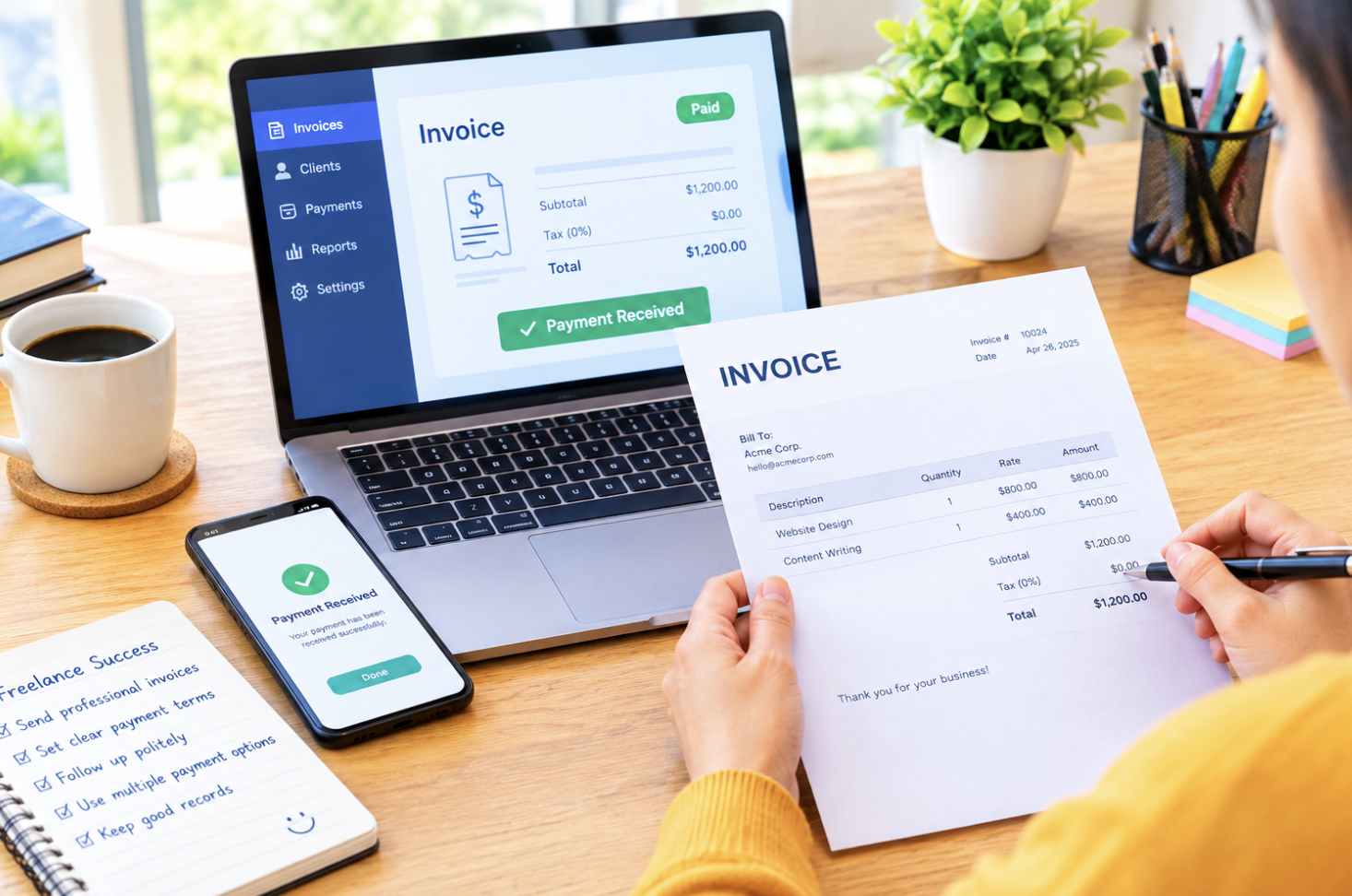
A complete invoice removes ambiguity and gives a client’s finance team everything needed to process payment without follow-up questions.
- A unique invoice number for tracking and reference in both parties’ records
- Clear contact and payment details for both the freelancer and the client
- An itemized breakdown of services rendered, with rates and quantities
- The total amount due, stated prominently rather than buried in a table
- A specific due date rather than a vague term like “net 30 from receipt”
- Accepted payment methods and any relevant account details
Missing even one of these elements gives a client an easy excuse to delay, whether intentional or not. Accounts payable departments at larger companies in particular tend to reject or set aside incomplete invoices automatically, restarting the clock once a corrected version is submitted.
Setting Payment Terms Before Work Begins, Not After
The single biggest invoicing mistake freelancers make isn’t in the invoice itself, it’s discussing payment terms for the first time when the invoice goes out. Payment terms belong in the initial contract or proposal, agreed upon before any work starts. Net 15 or net 30 terms should be spelled out clearly, along with what happens if payment is late. A client who already agreed in writing to a fifteen-day payment window has far less room to push back when that invoice arrives than one hearing the term for the first time on the invoice itself.
Choosing Invoice Timing Strategically
When an invoice goes out matters almost as much as what’s on it. Sending an invoice immediately upon project completion, rather than batching it with other administrative tasks for later, starts the payment clock as early as possible. For longer projects, breaking the work into milestone-based invoices, say, fifty percent upfront and fifty percent on delivery, reduces the total amount of money tied up in a single late payment and gives both parties natural checkpoints to confirm the relationship is on track. Recurring clients benefit from a consistent invoicing schedule, such as the first business day of each month, which sets a predictable rhythm both sides come to expect.
Requesting a Deposit for New Client Relationships
Working with an unfamiliar client carries more payment risk than working with an established one, and a deposit is the most direct way to manage that risk. A deposit of twenty-five to fifty percent collected before work begins accomplishes two things at once: it confirms the client is serious and financially prepared, and it protects the freelancer from doing substantial work with nothing to show for it if the relationship falls apart. Clients with legitimate budgets and serious intent rarely object to a reasonable deposit request, and pushback on this point is sometimes a useful early signal about how the rest of the payment relationship might go.
Handling Late Payments Without Damaging the Relationship
Late payments happen even with clear terms and good clients, and how they’re handled affects both the outcome and the ongoing relationship.
- A polite, factual reminder sent the day after a due date passes, rather than waiting weeks
- A follow-up phone call or direct message if email reminders go unanswered after a week
- A clearly stated late fee, applied consistently rather than as an occasional threat
- Escalation to a formal collections process only after repeated attempts at direct resolution fail
Most late payments stem from administrative delays rather than an unwillingness to pay, so a calm, professional first reminder resolves the majority of cases without any need for a harder conversation.
Using Invoicing Software Instead of Manual Documents
Manually created invoices in a word processor or spreadsheet work at a small scale but become error-prone and time-consuming as a freelance business grows. Dedicated invoicing software automates recurring elements, invoice numbering, tax calculations, payment reminders, and record-keeping, while also giving clients a professional, consistent format they can quickly recognize and process. Many platforms also track which invoices have been viewed by the client, removing the ambiguity of wondering whether an invoice simply hasn’t been opened yet or is actively being ignored.
Building Late Fees Into Contracts From the Start
A late fee clause works best as a deterrent that’s rarely actually needed, but it only functions that way if it’s established in writing before an invoice becomes overdue. A common structure charges one to two percent of the outstanding balance per month past the due date, disclosed clearly in both the contract and every invoice issued. Clients who see this term upfront tend to prioritize freelance invoices alongside other recurring obligations rather than treating them as flexible. Attempting to add a late fee retroactively, after a payment is already overdue, usually creates conflict rather than resolution.
Automating Recurring Invoices for Retainer Clients
Freelancers working with retainer or ongoing clients face a different invoicing challenge than one-off project work: the same invoice, essentially, needs to go out reliably every billing cycle without becoming an administrative burden. Manually recreating an invoice each month introduces unnecessary risk of errors, forgotten line items, or simply forgetting to send it on time amid other client work. Most invoicing platforms support recurring invoice templates that automatically generate and send an invoice on a fixed schedule, removing this task from a freelancer’s manual to-do list entirely.
- Setting a recurring invoice to generate a few days before the actual due date, rather than on the due date itself
- Building in automatic reminders for both the freelancer and client as the scheduled date approaches
- Reviewing recurring invoices periodically to confirm rates and scope still match the current agreement
- Keeping recurring and one-off project invoices in clearly separate tracking categories for easier bookkeeping
The consistency this creates benefits both sides of the relationship. Clients come to expect a predictable invoice on a predictable date, which tends to get paid faster than a similar invoice sent at an unpredictable time, simply because it fits neatly into whatever routine the client’s own accounts payable process has already built around it.
What to Do When a Client Simply Stops Responding
Every freelancer eventually encounters a client who goes silent after receiving an invoice, and how that situation gets handled matters both for recovering the payment and for protecting future income. The first step is usually a direct but professional message referencing the specific invoice number and amount, sent through a different channel than the original invoice if the first attempt goes unanswered. Sometimes an invoice legitimately gets lost in a busy inbox, and a second attempt through a different contact method resolves the issue without further escalation.
If direct outreach across a reasonable number of attempts produces no response, the next step typically involves a firmer, written final notice specifying a deadline before further action, such as late fees taking effect or the matter being referred to a collections process. For larger unpaid invoices, particularly involving contracts or written agreements, small claims court becomes a realistic option in many jurisdictions, often without requiring a lawyer for amounts below a certain threshold.
Keeping thorough documentation throughout a project, the original agreement, all correspondence, and every invoice sent, makes this kind of escalation far more straightforward if it ever becomes necessary, which is itself a strong argument for maintaining organized records even with clients who have never given any reason for concern.
Structuring Contracts to Support Faster Payment
An invoice is only as strong as the contract behind it, and many payment disputes trace back to ambiguity in the original agreement rather than anything wrong with the invoice itself. A well-structured freelance contract spells out not just the scope of work and total price, but the exact payment schedule, what happens if a project scope changes mid-way, and what recourse exists if payment is significantly delayed.
- Defining scope precisely enough that both parties agree on what constitutes “completed” work
- Specifying how scope changes affect pricing and payment timing before they occur, not after
- Including a kill fee or partial payment clause covering work already completed if a project is canceled early
- Stating explicitly which party covers any bank or platform fees associated with international payments
Contracts that leave these details vague tend to produce exactly the kind of payment disputes that make invoicing feel adversarial rather than routine. Investing time upfront in a clear, specific contract, even for smaller projects where it might feel unnecessary, consistently pays for itself in fewer payment delays and disputes down the line.
Setting Up a Simple Bookkeeping System Alongside Invoicing
Invoicing and bookkeeping are closely related but distinct tasks, and freelancers who treat them as a single combined afterthought often end up scrambling at tax time trying to reconstruct a year’s worth of
financial activity from memory and scattered records. A simple system tracking income by client and by month, alongside deductible business expenses as they occur rather than in a year-end rush, makes both tax preparation and day-to-day financial decision-making considerably easier.
- Recording income at the time an invoice is paid, not just when it’s sent, to track actual cash flow accurately
- Categorizing deductible expenses consistently throughout the year rather than reconstructing them later
- Setting aside a percentage of each payment for taxes, held in a separate account to avoid year-end surprises
- Reviewing income and expense totals monthly rather than only at tax time, catching irregularities early
This kind of ongoing bookkeeping discipline pays dividends beyond tax season too, since a freelancer with a clear, current picture of income patterns can make far better decisions about pricing, which clients are actually most profitable, and when it’s time to raise rates or drop a chronically late-paying client entirely.
Diversifying Income Streams Beyond a Single Client Base
Invoicing challenges often intensify when a freelancer’s income is concentrated among just one or two clients, since a single payment delay or lost client can create serious cash flow strain. Building a client base broad enough that no single client represents more than roughly a quarter of total income reduces this concentration risk considerably, even though it requires more active business development than relying on one or two dependable, high-volume clients.
- Client concentration above roughly twenty-five percent of total income creates meaningful financial vulnerability
- A broader client base reduces the impact of any single late or missed payment on overall cash flow
- Diversifying across industries or client types can also smooth out seasonal demand fluctuations
- Maintaining an emergency fund specifically sized for freelance income volatility provides an additional buffer
This diversification takes time to build and isn’t always immediately practical, particularly early in a freelance career when securing any steady client feels like the priority. But treating client diversification as an ongoing goal, rather than an afterthought only considered after a payment crisis, meaningfully improves long-term financial stability.
Conclusionn
For freelancers working across borders, the fees charged by payment platforms and banks for currency conversion can quietly eat into income if left unexamined. Two platforms advertising similar transfer speeds can differ by several percentage points once conversion markups and transfer fees are
factored in, which adds up meaningfully across a year of recurring invoices. Comparing actual received amounts, not just advertised fees, across a couple of payment options before settling on one for ongoing client work is a small step that can noticeably improve effective take-home pay over time, particularly for freelancers who regularly invoice clients based in a different currency than their own.
Read more about Newolt
Frequently Asked Questions
1. What payment terms are considered standard for freelancers?
Net 15 and net 30 are the most common terms, though newer or lower-trust client relationships often start with shorter terms like net 7 or upfront deposits. Established, recurring clients can sometimes justify longer terms, but freelancers should weigh cash flow needs carefully before agreeing to anything beyond net 30.
2. Should I charge interest or a flat fee for late payments?
Both approaches work, and the choice largely comes down to preference and local regulations. A flat percentage of the invoice total per month is simpler to calculate and communicate than compounding interest, and it’s the more common approach among independent freelancers.
3. How do I handle a client who disputes an invoice after receiving the work?
Address disputes promptly and in writing, referencing the original contract or proposal terms. If the scope of work matches what was agreed upon, calmly restate the terms and ask specifically what aspect is being disputed. Vague disputes without specifics are sometimes a delay tactic rather than a disagreement about the work itself.
4. Is it appropriate to pause work on future deliverables until a past invoice is paid?
For ongoing or multi-phase projects, this is a reasonable and commonly used approach, particularly when a contract includes a clause allowing it. Communicating the pause clearly and professionally, tied directly to the specific overdue invoice, keeps the situation from escalating unnecessarily.
5. Do I need to charge sales tax on freelance invoices?
This depends entirely on local tax regulations, the type of service provided, and sometimes the client’s location. Freelancers should confirm their specific tax obligations with a local accountant or tax authority rather than assuming a blanket rule applies across all jurisdictions and service types.
6. How should international clients be invoiced differently?
International invoices should clearly state the currency being used and account for potential currency conversion fees on either side. Payment methods that support international transfers efficiently, such as certain online payment platforms, often reduce delays and fees compared to traditional international bank wires.