

So you want to turn your camera obsession into actual money. Brilliant. Also slightly terrifying. But mostly brilliant.
The good news is that learning how to start a photography business is not as complicated as most people make it sound. You do not need a fancy degree, a massive budget, or connections to every photographer in your city. You need a plan, some honest effort, and the willingness to learn from your mistakes along the way.
This guide covers everything from picking your niche to pricing your work to getting your first clients. Let us get into it.
Quick Summary: To start a photography business you need to choose a niche, write a business plan, sort out the legal setup, invest in the right equipment, build a portfolio, create a website with SEO, set your pricing, build your branding, market on social media, and network to get clients. Do it in order and do not skip the boring parts.
Why Most Photography Businesses Fail Before They Even Launch
Here is the hard truth. Most people who want to start a photography business spend weeks researching cameras and zero time thinking about the actual business side. They buy equipment they cannot afford, have no website, no clients, and no plan — and then wonder why nothing is working.
Running a photography business is not just about taking beautiful photos. It is about marketing yourself, managing finances, building relationships, and showing up consistently. The photography part is honestly the easy bit. The business part is where most people get stuck.
Good news? With a proper photography business plan in place before you start, you put yourself ahead of about seventy percent of the competition immediately. That is not a joke. Most photographers just wing it. Do not be that photographer.
Step 1 — Figure Out Your Photography Niche Before Anything Else
Before you buy a single lens or build a website, you need to answer one question. What kind of photography do you actually want to do?
This is called picking your photography niche and it matters more than almost anything else in the early stages of building your business.
| Photography Niche | Best For | Income Potential |
|---|---|---|
| Wedding photography | People who thrive under pressure and love big emotional moments | Very High |
| Portrait photography | Beginners wanting consistent, repeatable local work | Moderate to High |
| Commercial photography | Photographers comfortable working with business clients | High |
| Product photography | Studio-focused photographers, e-commerce market | High and growing |
Wedding photography is one of the most popular and lucrative niches but also one of the most demanding. Weddings happen once. There are no do-overs. The pressure is real but so is the income potential.
Portrait photography covers individuals, families, newborns, seniors, and headshots. It is consistent, repeatable, and builds a strong local client base relatively quickly. Great choice for beginners who want steady work.
Commercial photography means shooting for businesses — products, buildings, events, and corporate material. The pay rates are higher but the client expectations are too.
Product photography is booming right now because of e-commerce. Brands need clean, professional images constantly. If you like working in a studio with controlled lighting, this niche is worth serious consideration.
Pick one or two areas to focus on first. You can always expand later once you are established. Trying to do everything at once is a recipe for being average at everything.
Step 2 — Write an Actual Photography Business Plan
This part sounds boring. But stay with me because skipping this step is one of the main reasons photography businesses fail within the first year.
A photography business plan does not need to be fifty pages long. It just needs to answer some specific questions that will guide every decision you make going forward.
What Your Photography Business Plan Should Cover
- What services will you offer and in which niche?
- Who is your ideal client — age, location, budget?
- What are your photography startup costs?
- What will you charge for your services?
- How will you find and attract clients?
- What is your income goal for year one?
- What does success look like in three years?
Your photography business plan should also include some basic financial projections. What do you need to earn each month to cover your costs and pay yourself? Work backwards from that number to understand how many shoots you need to book. Simple maths but it completely changes how you think about pricing and client acquisition from day one.
Step 3 — Sort Out the Legal Stuff Early
Nobody loves this part. But doing it wrong costs way more time and money than doing it right upfront. So just get it done.
Choose Your Photography Business Name
Keep it simple. Many successful photographers just use their own name followed by Photography. It is clean, personal, and easy for clients to remember and search for. If you want something more brand-like, make sure it is not already taken and check that the domain name is available before you commit to it.
Set Up Your LLC Photography Business
For most photographers starting out, setting up an LLC photography business is the smart choice. An LLC separates your personal finances from your business finances. If something goes wrong — a client dispute, equipment damage at a shoot, anything at all — your personal assets are protected. Sole proprietorships are simpler to set up but offer far less protection. The LLC setup cost is worth every penny.
Get Your Business License and Insurance
You will need a business license photography in your area. Requirements vary by city and state so do a quick search for your specific location. It is usually not expensive or complicated but operating without one is a risk you do not want to take once you are earning money.
Photography insurance is non-negotiable. Equipment gets stolen. Accidents happen at shoots. Clients occasionally get very unhappy. General liability insurance plus equipment coverage is the baseline. It costs less than you think and protects everything you have built.
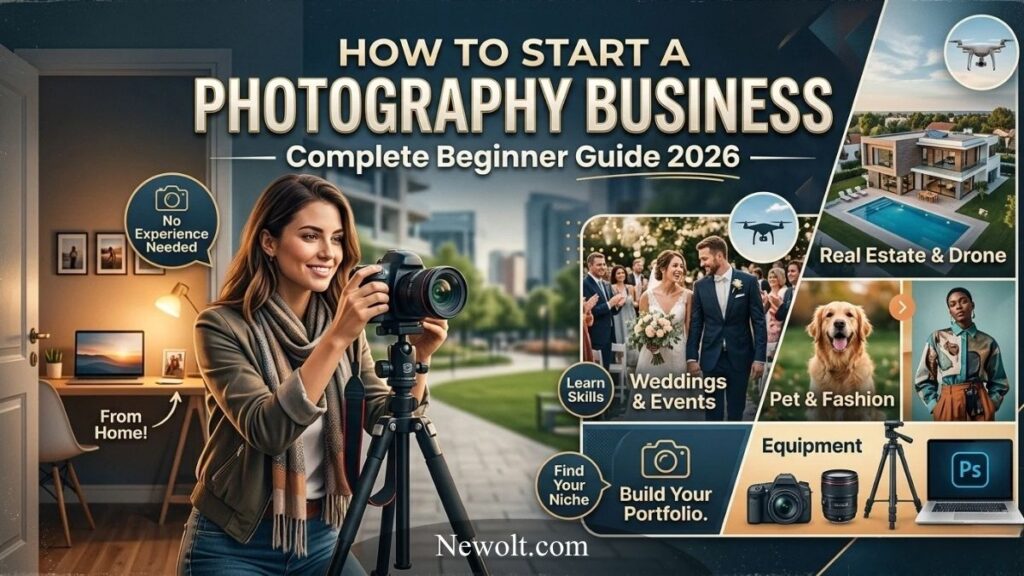
Step 4 — Invest in the Right Photography Equipment
Here is where people go completely off the rails. They spend everything they have on gear before they have a single client. Please do not do this.
You do not need the most expensive camera on the market to start a photography business. You need a reliable camera body, a good camera lens or two, and editing software. That is genuinely it to get started.
Essential Photography Equipment to Start
- Camera body — mid-range mirrorless or DSLR from Canon, Nikon, or Sony
- Camera lenses — a versatile 24-70mm zoom and a sharp 50mm prime to start
- Editing software — Adobe Lightroom for colour grading and batch editing
- Memory cards — multiple cards, never rely on just one
- External hard drive — for backing up all your images
- Camera bag — to protect everything when travelling to shoots
For camera lenses specifically, a 24-70mm f/2.8 is the workhorse lens that covers almost every situation. If budget is tight, a 50mm f/1.8 is one of the sharpest and most affordable lenses available on any camera system and produces beautiful results.
On the software side, Adobe Lightroom is the industry standard for editing, organizing, and exporting images. It is part of the Adobe Creative Cloud photography plan and genuinely excellent for colour grading, batch editing, and delivering client galleries professionally. Photoshop pairs with it perfectly for more advanced retouching work.
Start lean. Invest more as your business generates revenue. Renting photography equipment for specific high-value shoots is a perfectly smart strategy while you are building your client base.
Step 5 — Build a Photography Portfolio That Actually Attracts Clients
Your photography portfolio is the most important marketing tool you have. It is what clients look at before they decide whether to hire you. So it needs to be good — and it needs to be focused.
If you are just starting out and do not have paying clients yet, do test shoots. Reach out to friends, family, or people in local Facebook groups who want free photos in exchange for you using the images in your portfolio. Be very selective. Only show your absolute best work. Ten stunning images beat fifty average ones every single time.
Your photography portfolio should be focused on the niche you have chosen. If you want to shoot weddings, your portfolio needs wedding images. If you want to shoot products, it needs product images. A portfolio full of random miscellaneous photos from every genre sends a confusing message to potential clients about what you actually do.
Once you have twenty to thirty strong images in your chosen niche, you are ready to build your photography website and start taking on paying clients.
Step 6 — Create a Photography Website That Actually Gets Found
Your photography website is your digital storefront. And unlike social media, you own it completely. Algorithm changes, platform shutdowns, none of that affects your website. It is the most stable marketing asset your photography business has.
When building your site, focus on a few key things. Make it fast and mobile-friendly — most people visiting will be on their phones. Make it easy to navigate — gallery, about page, services, pricing information, and contact form. That covers everything you actually need.
SEO Photography Website Optimization — Do Not Skip This
Here is the part most photographers completely ignore and then wonder why nobody finds their website. SEO photography website optimization means that when someone in your city types “wedding photographer near me” or “portrait photographer in your city” into Google, your website has a real chance of appearing in the results. Without any SEO work, your beautiful website is essentially invisible to anyone who does not already know your name.
Use your location in your page titles, headings, and throughout your content naturally. Write clear descriptions of your services in plain language. Start a simple blog where you post about recent sessions, locations, and photography tips. These are the fundamentals that compound over time into real search traffic and actual client inquiries from people who have never heard of you before.
Step 7 — Set Your Photography Pricing Without Guessing
Photography pricing makes most beginners deeply uncomfortable. Either they charge too little out of fear of rejection or too much before they have the portfolio to justify it. The goal is to find the right middle ground that values your work while remaining competitive.
How to Research Photography Pricing in Your Area
Start by doing market research photography in your specific area. Look up five to ten local photographers in your niche. What are they charging for similar packages and services? This gives you a realistic starting range to work with rather than pulling numbers out of the air.
Then calculate your actual costs. Equipment, software, insurance, website, your time including editing hours — which most beginners dramatically underestimate. A two-hour shoot often means five or six additional hours of editing, culling, and exporting. Make sure your photography pricing accounts for all of that time or you are effectively working for free on the back end.
| Pricing Model | Best For | Client Experience |
|---|---|---|
| Flat-rate packages | Beginners and most niches | Clear and simple — easiest buying decision |
| Hourly rates | Commercial and editorial work | Flexible but less predictable for clients |
| A la carte pricing | Portrait and product photography | Customizable but can feel complicated |
Do not undersell yourself to compete with every photographer in town. Charge less than experienced photographers while you build your portfolio and reputation — that is completely reasonable. But do not charge so little that your photography business is not financially sustainable.
Step 8 — Build Your Photography Branding
Your photography branding is how people recognize you, remember you, and feel about you as a business. It is significantly bigger than just a photography logo.
Your photography logo is one piece of it. But your brand also includes the tone of your website copy, your colour palette, how you communicate with clients via email, and the overall aesthetic of your work. All of these things should feel consistent across every touchpoint a client has with your business.
You do not need to hire a professional designer on day one. Start simple. A clean wordmark with your photography business name and a consistent colour palette goes a long way in making you look professional and established. As your business generates income, investing in proper professional photography branding becomes genuinely worthwhile.
Your photography branding should reflect the clients you want to attract. If you shoot luxury weddings, everything about your brand should feel elevated and refined. If you shoot fun family portrait photography, your brand can be warm, approachable, and full of personality.
Step 9 — Get on Social Media the Right Way
Social media marketing photography is one of the most powerful and affordable tools available to photographers right now. Used consistently and strategically, it can build your audience and attract new clients without spending a penny on advertising.
Instagram Photography — Your Most Important Platform
Instagram photography is where most photographers build their audience and attract new clients organically. The platform is visually driven which makes it a natural fit. Post regularly, show your best work, share behind-the-scenes content, and engage genuinely with people in your comments and in your local community.
Use location-specific hashtags so people in your area can find you. Follow local businesses and wedding vendors in your niche. Build real relationships on the platform — those relationships lead to referrals and bookings more reliably than any algorithm trick ever will.
Pinterest is also worth your time especially for wedding photography and portrait photography. Pins have a much longer lifespan than Instagram posts and can drive consistent traffic to your photography website for months or even years after you post them.
Facebook still works well for local client acquisition photography — local groups, community pages, and targeted ads reaching your specific area can be very effective for building initial awareness when you are first launching.

Step 10 — Get Clients Through Networking Photographers and Building Relationships
Online presence matters enormously but networking photographers in your real-world community is what builds a sustainable photography business fastest in the early stages. Nothing replaces human connection when it comes to building trust with potential clients.
Networking by Photography Niche
For wedding photography, build relationships with wedding planners, florists, venues, and caterers. These vendors work with engaged couples constantly and a personal recommendation from them carries serious weight with their clients.
For portrait photography, connect with families and parents through local community groups, schools, and neighbourhood events. Offer a model call to build your portfolio while getting exposure to new potential clients who may book paid sessions later.
For commercial photography, attend local business events, chamber of commerce meetings, and industry networking nights. Decision makers at local companies are the people you need to know.
Word of Mouth Referrals — Your Strongest Marketing Tool
Word of mouth referrals are the most powerful form of client acquisition photography. When you do exceptional work and make clients feel genuinely taken care of, they tell people. They share your photos. They tag you on social media. They recommend you to friends who are planning weddings, expecting babies, or starting businesses.
Always ask happy clients for reviews and referrals. Most clients are genuinely happy to help — they just need to be asked directly. A simple message after delivery saying “If you loved your photos, I would be so grateful if you could share a review or recommend me to anyone who needs a photographer” works remarkably well.
Keeping Your Photography Startup Costs Under Control
Photography startup costs can spiral out of control fast if you are not careful. Here is a realistic breakdown of what you actually need to spend to get started properly.
Realistic Photography Startup Costs Breakdown
- Camera body and lenses — $500 to $3,000 depending on new versus used
- Adobe Lightroom subscription — approximately $10 to $20 per month
- Photography website hosting and domain — $100 to $300 per year
- LLC registration fees — $50 to $200 depending on your state
- Business license photography — $50 to $150 typically
- Photography insurance — $400 to $1,200 per year
- Basic marketing materials — $100 to $300
You do not need to buy everything at once. You do not need the newest camera body. You do not need a studio on day one. Start with what you genuinely need to deliver great results for clients in your chosen niche and invest more as your photography business generates revenue.
Rent equipment for specific high-value shoots until you can justify owning it. Buy used gear from reputable sellers — lenses in particular hold up extremely well when bought used from careful previous owners. Prioritize the investments that directly help you deliver better work and attract more clients.
Frequently Asked Questions
How much does it cost to start a photography business?
Photography startup costs typically range from $1,000 to $5,000 to get started properly. This includes a camera body and lenses, editing software like Adobe Lightroom, photography website hosting, business registration and LLC fees, photography insurance, and basic marketing. You can start leaner by buying used equipment and renting gear for specific shoots until your business generates enough revenue to invest more significantly.
Do I need an LLC for a photography business?
Setting up an LLC photography business is strongly recommended for most photographers. An LLC separates your personal finances from your business finances, protecting your personal assets if something goes wrong — a client dispute, accident at a shoot, or equipment damage claim. Sole proprietorships are simpler to set up but offer no personal asset protection. The setup cost is minimal compared to the protection it provides.
What photography niche is most profitable?
Wedding photography and commercial photography tend to have the highest earning potential. Wedding photography can command premium pricing for a single event. Commercial photography pays well because businesses have ongoing image needs. Product photography is growing rapidly due to e-commerce demand. Portrait photography provides consistent, repeatable income that builds a reliable local client base over time.
What equipment do I need to start a photography business?
To start a photography business you need a reliable camera body, one or two camera lenses, and editing software like Adobe Lightroom. A mid-range mirrorless or DSLR camera body paired with a versatile zoom lens and a sharp prime lens covers most shooting situations. You do not need the most expensive gear to start — buy what you can afford and upgrade as your business grows and generates income.
How do I get my first photography clients?
Getting your first photography clients involves multiple strategies working together. Offer free sessions to friends and family to build your portfolio. Use Instagram photography and social media marketing photography to showcase your work consistently. Optimize your photography website for local SEO so clients can find you on Google. Network with vendors in your niche and ask every happy client for referrals and reviews.
How do I set my photography pricing as a beginner?
Start by doing market research photography in your specific area — research what five to ten local photographers in your niche are charging for similar services. Then calculate your actual costs including equipment, software, insurance, website, and your time including editing hours. Build packages that cover your costs, value your time fairly, and remain competitive with other photographers at a similar experience level. Raise your prices as your portfolio and reputation grow.
How important is SEO for a photography website?
SEO photography website optimization is critically important for getting found by new clients who do not already know your name. Without local SEO, your website is essentially invisible to anyone searching for a photographer in your area on Google. Use your location in page titles and headings, write clear service descriptions, and start a simple blog about recent sessions and local locations. These fundamentals compound over time into real search traffic and consistent client inquiries.
Final Thoughts — Stop Waiting and Start Shooting
The biggest mistake people make when thinking about how to start a photography business is waiting until everything is perfect. The perfect camera. The perfect website. The perfect portfolio. There is no perfect. There is only starting.
Start with what you have. Take on free work to build your photography portfolio. Set up your LLC. Get your photography insurance sorted. Build a simple photography website. Start posting on Instagram. Tell everyone you know what you are doing and what photography niche you are focusing on.
Every successful photography business started exactly where you are right now. The ones that made it are simply the ones that actually started — and kept going when it got difficult.