Indoor air carries dust, pollen, smoke particles, pet dander and cooking fumes, and most of us spend the large majority of our time breathing it. A well-chosen air purifier can lower the amount of fine particles in a room, but a badly chosen one is an expensive and noisy ornament.
In this article we will explore how to size a purifier for your room, how the different filters work, what the machine costs to run, and how to place, use and maintain it so your money is well spent.
Clean air delivery rate sets the size of the machine
The single most useful number on a purifier box is its clean air delivery rate, usually shortened to CADR. It describes how much filtered air the machine produces in a given time, and in the United States it is tested by an industry programme that gives separate figures for smoke, dust and pollen. Those figures are normally shown in cubic feet per minute, while many other countries quote cubic metres per hour. A bigger number means the unit can clean a bigger room, or the same room faster.
The easiest way to turn that number into a buying decision is to think in air changes per hour. A commonly recommended target for a bedroom or living room is four to five air changes per hour, which means the machine moves the full volume of the room through its filter that many times every hour. To work it out, multiply the floor area by the ceiling height to get the room volume, then compare it with the CADR. If your CADR is given in cubic metres per hour, divide it by the room volume in cubic metres and you have the air changes per hour directly.
There is also a widely quoted shortcut known as the two-thirds rule. It says the smoke CADR in cubic feet per minute should be at least two-thirds of the floor area in square feet, assuming a ceiling around eight feet high. A room of 150 square feet would therefore want a smoke CADR of about 100. This rule is a rough guide, and it is best used as a minimum rather than a perfect fit.
Several details can push you towards a larger unit. High ceilings add volume that the simple floor-area rule ignores. A household with smokers, pets, a wood stove or a person with allergies often wants a faster turnover than the minimum. A purifier also loses effectiveness as its filter loads with dust, so a little spare capacity means you can run it on a quieter, lower setting and still hit your target.
Be wary of the area figure printed in large type on the front of many boxes. That number is sometimes based on assumptions that favour the manufacturer, such as only one air change per hour or a long running time. Use it as a hint, then check the measured CADR or the stated airflow before you decide. If a product gives no independent airflow figure at all, treat that as a reason to look at another model.
HEPA filtration captures the fine particles that matter
The filter is the heart of a purifier, and the type you want for particles is HEPA, which stands for high efficiency particulate air. A true HEPA filter is a dense mat of very fine fibres. It traps particles by several mechanisms at once, so it works well on large specks that collide with fibres and on the tiniest particles that drift about randomly and stick. The size that is hardest to catch sits at a few tenths of a micron, and standards are written around that difficult size.
In the United States, a filter sold as true HEPA is expected to remove at least 99.97 percent of particles of 0.3 micron. In Europe the grades are called H13 and H14, and H13 is commonly described as removing at least 99.95 percent at its most penetrating size. Both are strong results, and the difference between them is small in practice. Phrases such as “HEPA-type”, “HEPA-style” or “99 percent filtration” usually mean a lesser filter that has not passed the same test, so read the wording closely.
Particle filtration matters because fine particles, including those from smoke and traffic, are the part of indoor air most strongly linked with health effects in published guidance. A HEPA purifier can lower the concentration of these particles in a room, which is why such devices are often suggested for wildfire smoke periods and for households with allergies. The benefits for any one person depend on the sources in the home, the size of the room and how consistently the unit runs. It is sensible to treat a purifier as one helpful measure rather than a cure.
A good purifier also needs a sealed path, meaning the air must be forced through the filter rather than around it. Cheap units sometimes have gaps at the edges, and air that slips past an unsealed frame is never cleaned. Pressing a hand lightly around the filter seat while the machine runs is not a scientific test, but it can reveal a loose fit. A reputable model will have a snug gasket and a clear instruction on how the filter should be seated.
Many models also include a coarse pre-filter, a washable mesh or foam layer that catches hair and large dust. This layer protects the HEPA filter and extends its life, and cleaning it every few weeks is one of the cheapest ways to keep costs down. If the pre-filter is missing, the main filter clogs sooner and the replacement bill arrives earlier.
Activated carbon handles odours and some gases
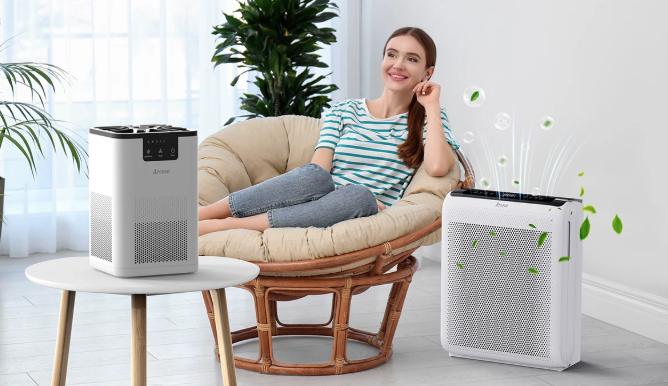
HEPA filters only capture particles, so they do nothing for smells, cooking vapours or most chemical gases. For these, purifiers use activated carbon, a very porous material with a huge internal surface that holds gas molecules on it. The more carbon a filter contains, the longer it lasts and the more it can hold. A thin, black-tinted sheet that is described as a carbon filter may do very little, while a thick bed of loose carbon granules can make a clear difference.
If your main concern is pollen, dust and pet dander, carbon is a nice extra rather than a requirement. If your concerns include cooking smells, tobacco smoke, new furniture odours or traffic fumes, a substantial carbon stage becomes a real part of the specification. Look for the weight of carbon in the product details, because larger purifiers aimed at gases often list it in kilograms. A figure of a few hundred grams usually suggests a light odour-reducing layer.
Carbon has a limited capacity, and once it fills up it can stop working or even release some of what it captured. This is why a carbon filter generally needs replacing sooner than a HEPA filter, and why heavy odour sources shorten its life. Many people notice that the smell returns, which is a practical signal that the carbon is spent. Manufacturers state replacement intervals, but your own nose is a useful check.
It is worth being realistic about gases. Household air can contain many different chemicals, and carbon does not capture all of them equally well. Some small molecules, including certain common indoor pollutants, are adsorbed poorly by ordinary carbon. If a gas is the central problem, such as fumes from a source in the home, the best response is to remove or reduce the source and to ventilate, with the purifier as a helper.
Some filters add other materials, for example carbon blended with an agent meant to treat a specific compound. These can be useful for a defined problem, but the claims should be modest and specific. Vague promises that a filter removes “all chemicals” or “every pollutant” are a sign to look at the evidence more carefully before paying extra.
Room size and placement decide real performance
Even a well-sized unit can disappoint if it is put in the wrong spot. Air purifiers clean the air that passes through them, and the rest of the room benefits as the air mixes. Place the machine where airflow can reach it freely, with a clear gap around the intake and outlet. Manufacturers often suggest leaving something like 20 to 30 centimetres, or about a foot, between the unit and walls or furniture, and the manual will give the exact figure.
Choose the room where you spend the most time. For most people that is the bedroom, since we sleep there for hours with the door shut, and a quiet unit running overnight gives a long period of cleaner air. If you work from home, a second unit or a portable one for the office may be more useful than a large machine in the hallway. A single purifier does not clean an entire house, especially an open-plan one with several rooms and many doors.
Close doors and windows while the machine runs on higher settings, because otherwise it is cleaning air that keeps being replaced by outdoor air. This matters most during smoke or pollen episodes. At other times, regular ventilation is still valuable, since it dilutes gases and moisture that a purifier cannot remove. A sensible pattern is to ventilate when outdoor air is good, and to rely on the purifier when it is not.
Put the unit away from sources that will clog it quickly. Placing it right beside a radiator, a litter tray or a doorway to the kitchen may overload the filter. Avoid enclosing it in a corner or behind a sofa, since this strangles the airflow. Keep it off the floor of a dusty carpet if the intake is low, or on a stable surface that does not stir up settled dust.
Think also about power cords and safety. Keep the cable out of walkways, and do not run a purifier near water or in a damp bathroom unless it is made for it. If there are small children or pets, choose a model with a sturdy base and a protected control panel. A unit that tips easily is a nuisance, and a child lock on the buttons prevents settings being changed.
| Room type | Typical size | What to prioritise | Placement tip |
| Small bedroom | Up to about 12 square metres | Low noise on the night setting | Beside the bed, with space around the intake |
| Living room | About 20 to 35 square metres | Higher airflow and a carbon stage | Away from walls, with doors kept closed |
| Home office | About 8 to 15 square metres | Quiet running during calls | Near your desk but not in direct line with your face |
| Open-plan space | Larger than 35 square metres | Very high airflow or two units | Spread units across zones |
Running costs come from electricity and replacement filters
The price on the box is only the start, because two ongoing costs follow you home. The first is electricity, which is easy to estimate. Find the wattage on the label or in the manual for each fan speed, multiply by the hours of use, divide by 1,000 to get kilowatt-hours, and multiply by your own tariff. For example, a unit drawing 30 watts for 24 hours uses 0.72 kilowatt-hours, and at an illustrative tariff of 0.20 per kilowatt-hour that is about 0.14 per day.
The power draw varies a lot with speed. Fans use far more energy at the top setting than at the lowest, so a unit that spends most of its time on a low speed costs less than the label’s maximum figure suggests. Many machines also have an automatic mode that reads air quality and adjusts. That can save energy, but it depends on the quality of the sensor, which is often a rough guide rather than a precise instrument. If your electricity price changes by time of day, running the unit on a quieter setting overnight is often both cheap and quiet.
The second cost, replacement filters, is the one that surprises people. A HEPA filter commonly lasts somewhere between six and twelve months in typical home use, and a carbon filter often needs changing sooner, although each manufacturer gives its own figures. Over three to five years the filters can cost more than the machine itself. Before you buy, look up the price and availability of the replacement set and calculate the yearly cost.
A simple way to compare models is to add the purchase price, the expected electricity over a few years and the filters over the same period, then divide by the number of years. This often shows that a cheaper unit with expensive filters is dearer in the end than a mid-priced one with long-lasting filters. Washable pre-filters and filters that last longer lower the annual figure. Check that third-party filters, if you consider them, are tested and fit properly, since a poorly fitting copy can leak and defeat the point.
Do not forget the cost of the wrong choice. A unit that is too small for the room has to run on high all the time, which raises noise, wear and power use, yet still falls short of the target. A unit that is too noisy gets switched off, so all the money spent is wasted. Paying a little more for the right capacity and a quiet motor is usually the economical decision.
Noise, settings and daily habits shape how often it runs
A purifier only helps while it is running, and the factor that decides whether people keep it on is noise. Manufacturers give sound levels in decibels, usually measured near the unit at various speeds. The lowest setting on a good model is close to a soft background hum, while the highest setting can be loud enough to disturb conversation. Remember that the decibel scale is logarithmic, so a difference of ten decibels is a big change in how loud it feels.
Plan to use the machine on a low or medium speed for long periods, with occasional bursts on high. Running quietly all day usually cleans better than blasting for twenty minutes and then switching off, because new particles arrive constantly from cooking, cleaning and movement. When you cook or vacuum, turn up the speed for a short time and then return to normal. At night, use the sleep mode if it dims the lights and lowers the fan.
Lights and displays can be a nuisance in a bedroom. A good bedroom unit lets you turn off the indicator lights, or dims them automatically. Some people prefer a very low steady hum, because it masks outside noise, while others find any sound distracting. Try it for a few nights before the return period ends, and keep the receipt and packaging until you are certain.
Habits matter as much as hardware. Wet-mopping or using a vacuum with a good filter lowers the dust that the purifier would otherwise have to remove. Taking shoes off at the door, washing bedding regularly and keeping pets off the bed reduce particle sources. Using the extractor fan while cooking, and not burning candles or incense in the main room, cuts the load on the filter and keeps running costs lower.
If someone in the household has asthma, allergies or another respiratory condition, a purifier is only one part of a plan agreed with their doctor. Do not stop prescribed treatment because you bought a machine. If symptoms get worse, or if you notice breathlessness, wheezing or a persistent cough, see a doctor rather than relying on the device to fix the problem.
Features to skip and claims to treat with caution
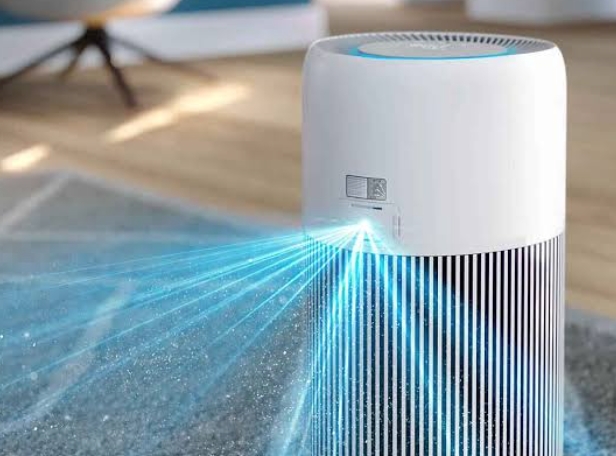
Some of the most heavily marketed features offer the least value. Ozone generators, which are sometimes sold as “air cleaners” or “air fresheners”, release ozone on purpose, and ozone is a lung irritant. Public health agencies advise against using them in occupied spaces, and some regions restrict their sale. A purifier that deliberately produces ozone is the opposite of what a healthy home needs.
Ionizers and similar charged-particle devices are more varied. Some are acceptable, but certain designs produce small amounts of ozone as a by-product, and the particles they charge may simply stick to walls and furniture instead of being removed. Look for a statement that the product meets the local limit on ozone emissions, and treat a purifier whose main claim is ionization with caution. A filter-based unit with a fan is easier to evaluate and more dependable.
Ultraviolet light and photocatalytic systems are often advertised for killing germs. Real effectiveness depends on the dose, which is the intensity and the time that air spends exposed, and in a small, quick-moving purifier that exposure can be very short. Some of these systems can also create unwanted by-products. If you like the feature, treat it as an extra, and do not accept it as a replacement for a proper HEPA filter.
Smart features such as app control, scheduling and live air-quality readouts are convenient, but the sensors in consumer products are typically simple. They tend to be good at showing trends, such as the air improving after a cooking spike, and less good as an exact measurement. Do not make health decisions based only on a number on a small screen. If you want more reliable monitoring, a separate dedicated monitor from a reputable source may be a better purchase.
Finally, watch for sweeping health claims. A box that promises to remove “99.9 percent of viruses” or to cure allergies is making a promise that depends on test conditions you cannot see. Reputable manufacturers describe what was measured, in what size of room and over how long. If the claim is vague and the evidence is not given, assume the benefit is smaller than advertised.
Maintenance keeps a purifier working as designed
A purifier needs only a little attention, but that attention is what keeps it effective. Start by reading the manual to find where the filters sit, how to open the unit and how often each part should be changed. Write the next replacement date on a calendar or set a phone reminder when you install a new filter. Many models have a filter indicator, but it often counts running hours rather than measuring dirt, so it is only a rough guide.
Clean the exterior and the air intake grille regularly with a dry or slightly damp cloth, with the unit unplugged. A vacuum cleaner with a soft brush can lift dust from the grille and the pre-filter. Never wash a HEPA filter unless the manufacturer says it is washable, because water can damage the fibres and ruin the filter. Let washable parts dry completely before refitting them to avoid mould.
When the time comes to change the filter, handle it carefully. Wear a mask if you are sensitive to dust, take the old filter outdoors if you can, and seal it in a bag before throwing it away. Wipe the inside of the housing, check that the new filter is oriented correctly, and make sure any plastic wrapping has been removed. A filter installed in its wrapper is a surprisingly common mistake and means no air is cleaned.
Replace filters earlier than scheduled in heavy-use situations. After a wildfire smoke period, a home renovation with sanding, or an episode of heavy cooking fumes, filters can fill much faster than the normal interval suggests. If the airflow from the outlet seems weak, the fan sounds strained or the smell returns, inspect the filter. Putting off a change saves money for a week or two but makes the motor work harder.
Store spare filters in a clean, dry place in their original packaging. Keep the manual and the warranty details together, and register the product if the manufacturer offers it. If the machine develops a burning smell, makes grinding noises or trips a fuse, stop using it and contact the seller or a qualified repairer. Do not try to open the electrical parts yourself.
Conclusion
Begin with the room, not the product. Measure the floor area and ceiling height of the space where you spend the most time, calculate the volume, and decide on a target of about four to five air changes per hour. Then look at purifiers whose measured CADR meets that figure at a speed you could tolerate for long periods. This one step removes most of the poor choices from your shortlist.
Next, check the filter specification. For particles, insist on a true HEPA or an H13 grade filter, and for odours look for a meaningful quantity of activated carbon. Look up the price and the expected life of the replacement filters, and add that to your yearly cost estimate along with electricity. Read the sound levels at the low and medium speeds, because that is where the machine will spend its time.
After the purchase, put the unit in the right spot, keep the door closed in that room, and let it run on a steady setting. Reduce the sources of pollution at the same time by ventilating while cooking, avoiding smoking indoors, and cleaning regularly. Mark filter changes on a calendar, so that the machine keeps doing the job you paid for.
If you or a family member has a lung condition, allergies or symptoms that worry you, talk to a doctor about what will help, and mention the purifier as part of the plan. Where there is a fuel-burning appliance in the home, remember that a purifier does not remove carbon monoxide, so a working carbon monoxide alarm is still essential. Good air at home comes from several habits working together, and a properly sized purifier is a useful part of that set.
Read more about Newolt