Curly hair behaves fundamentally differently from straight hair, and routines built for straight hair often work against curly hair’s natural tendencies rather than supporting them. Understanding why curly hair needs a different approach makes it far easier to build a routine that actually reduces frizz and enhances natural curl pattern, rather than fighting it.
Understanding Curl Types
Curl patterns are commonly categorized from loose waves through tight coils, with finer sub-categories within each broader type based on how tightly the curl or coil forms. Knowing your general curl type helps guide product weight and technique choices, since a product formulated for very tight coils can weigh down looser waves, while a lightweight product made for loose waves may not provide enough hold or moisture for tighter curl patterns.
Choosing a Shampoo and Conditioner Free of Harsh Ingredients
Sulfates, a common foaming ingredient in many mainstream shampoos, tend to be especially drying for curly hair, and many curly hair routines specifically favor sulfate-free formulas for this reason. Similarly, silicones in conditioners can build up over time and weigh curls down without rinsing out fully with water alone, which is part of why a periodic clarifying wash, mentioned earlier, matters even within an otherwise gentle routine.
Why Curly Hair Needs Different Care
Curly hair’s natural oils have a harder time traveling down the length of each strand compared to straight hair, due to the bends and turns in the hair shaft, which is why curly hair tends to be drier overall and generally benefits from richer, more moisturizing products than straight hair typically needs.
Cleansing Frequency and Co-Washing
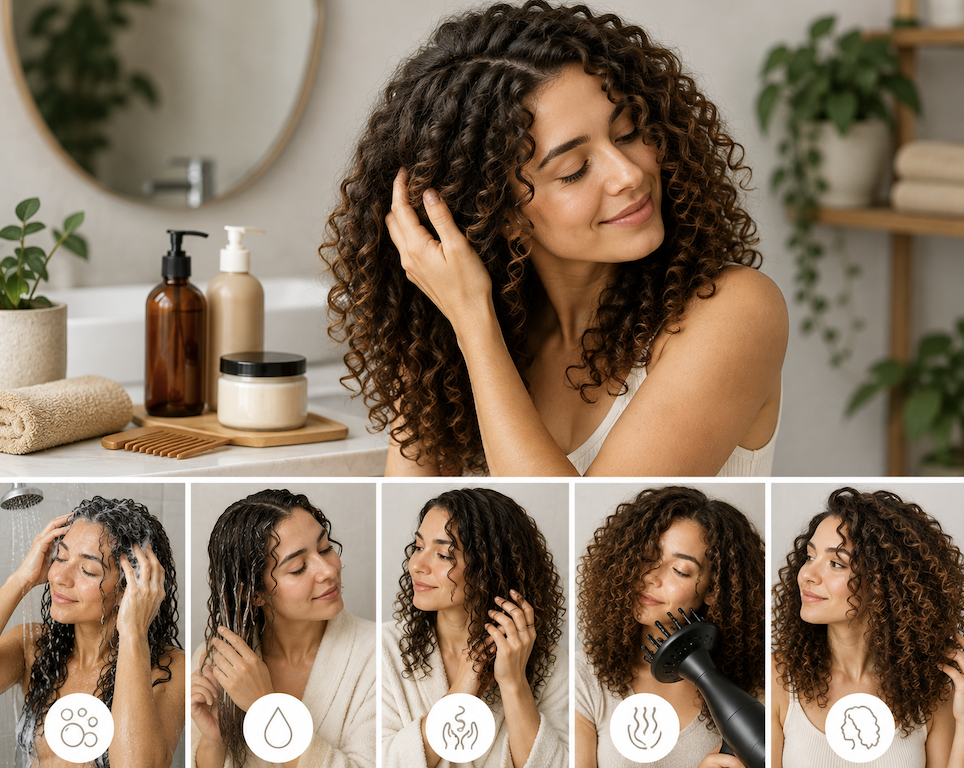
Washing curly hair with a traditional shampoo every day can strip away the natural oils it already struggles to retain, which is why many curly hair routines favor washing less frequently, sometimes just once or twice a week. Co-washing, using a cleansing conditioner instead of traditional shampoo on non-wash days, cleanses the scalp gently while avoiding the more aggressive stripping effect of regular shampoo, though a proper clarifying shampoo periodically is still worth using to remove product buildup that co-washing alone won’t fully clear.
Why Conditioner Matters More for Curly Hair
Conditioner plays a larger role in a curly hair routine than it typically does for straight hair, both for detangling and for supplying the moisture curly hair’s structure makes harder to retain naturally. A rich, moisturizing conditioner, left on for a few extra minutes beyond the standard rinse time, gives curly hair meaningfully better results than a quick rinse-and-go approach.
Deep Conditioning Treatments
Beyond regular conditioner, a weekly or biweekly deep conditioning treatment, left on longer than a standard conditioner (often with heat from a shower cap or warm towel to help the product penetrate more effectively), provides an extra moisture boost that curly hair often needs beyond what daily conditioning alone provides. This is particularly worth prioritizing for tighter curl and coil patterns, which tend to need more intensive moisture support than looser wave patterns.
Detangling Technique
Detangling curly hair while dry, or on already-tangled dry hair with a standard brush, tends to cause more breakage and disrupt the natural curl pattern. Detangling in the shower with conditioner still in the hair, using fingers or a wide-tooth comb starting from the ends and working upward toward the roots, causes significantly less damage and breakage than detangling dry hair from root to tip.
Drying Methods: Plopping
Plopping involves wrapping wet, product-applied hair in a microfiber towel or soft cotton t-shirt, rather than a standard terry cloth towel, which tends to cause more frizz through rough friction against the curl pattern. This method absorbs excess water gently while encouraging curls to clump together and form their natural shape as they begin to dry.
Choosing the Right Diffuser Attachment and Heat Setting
Not all diffuser attachments are equal, and a shallow, wide-bowl diffuser generally cradles curls more gently than a narrow, deep-bowl design, reducing frizz during the drying process. Keeping heat on a low or medium setting, even if it extends drying time somewhat, protects curl pattern and hair health better than using high heat purely to finish drying faster.
Drying Methods: Diffusing
A diffuser attachment on a blow dryer distributes airflow more gently and evenly across a wider area than a standard dryer nozzle, reducing the frizz-inducing effect that direct, concentrated airflow has on curl patterns. Diffusing on a lower heat and speed setting, while gently cupping sections of hair upward toward the scalp, helps curls dry into their natural shape rather than being blown out of pattern.
Air Drying as an Alternative
Air drying avoids heat exposure entirely but takes considerably longer and can sometimes result in curls that look slightly less defined than a properly diffused result, particularly for looser wave patterns that benefit from a bit of upward lift during drying. For hair that tends toward more definition naturally, air drying after plopping is often sufficient without needing to diffuse at all.
Applying Products to Soaking Wet Hair
Curly hair generally holds styling products best when applied to soaking wet, rather than towel-dried or damp, hair, since the extra water helps distribute product evenly and activates certain ingredients designed to define curl pattern. Applying product section by section while hair is still dripping, rather than waiting until it’s partially dried, tends to produce noticeably better curl definition by the time hair fully dries.
The LOC Method for Product Layering
The LOC method Liquid, Oil, Cream, applied in that specific order is a commonly used product layering approach for curly hair, starting with a water-based liquid or leave-in conditioner, followed by a sealing oil, and finished with a styling cream to define and hold the curl pattern. This layered approach helps lock in moisture more effectively than any single product applied alone, which is particularly useful for curl types that dry out more quickly throughout the day.
Avoiding and Managing Frizz
Frizz often results from a combination of insufficient moisture, rough handling while wet, and friction against certain fabrics while sleeping or during the day. Addressing all three factors together — adequate product, gentle handling, and reduced friction — tends to control frizz more effectively than focusing on a single cause alone, like assuming more product will fix frizz caused primarily by rough towel drying.
Choosing Silk or Satin Hair Accessories
Beyond pillowcases, hair ties and scarves made from satin or silk cause less friction and breakage at the point of contact than standard elastic hair ties or cotton scarves, which is particularly relevant for anyone regularly securing curls into a pineapple or protective style overnight or during the day.
Nighttime Protection
Sleeping on standard cotton pillowcases creates friction that disrupts curl pattern and increases frizz overnight. A satin or silk pillowcase reduces this friction significantly, and for very curly or coily hair, loosely gathering hair into a high, soft “pineapple” style before bed helps preserve curl shape and volume better than letting hair rest flat against the pillow all night.
Protective Styling as a Curl Care Strategy
Low-manipulation protective styles loose braids, twists, or buns that don’t require daily restyling can reduce daily manipulation and friction, which is one of the more overlooked contributors to breakage and frizz over time. These styles work well as an occasional break from daily wash-and-go routines, particularly during busier weeks or when hair needs extra time to recover from heat or chemical treatments.
Trimming and Split Ends
Split ends on curly hair tend to be more visually noticeable than on straight hair, since a split end can disrupt an entire curl’s shape rather than just the very tip of a straight strand. Regular trims, even just a small amount every few months, help maintain overall curl definition and prevent existing splits from traveling further up the hair shaft over time.
Protecting Curls From Sun and Chlorine Exposure
Extended sun exposure can dry out curly hair similarly to how it affects skin, and chlorine from swimming pools strips moisture and natural oils aggressively. Wetting hair with clean water before swimming, so it absorbs less chlorinated pool water, and rinsing thoroughly afterward with a clarifying treatment when needed, helps protect curl health during summer months or frequent swimming.
Building a Routine by Curl Type
Looser wave patterns generally do well with lighter products and less frequent washing than originally assumed, since heavier products can weigh looser waves down and reduce their natural movement. Tighter curl and coil patterns generally benefit from richer, heavier products and more consistent moisture, given how much drier these tighter patterns tend to be by nature. Adjusting product weight to match your specific curl pattern, rather than assuming one universal curly hair routine works for every curl type, produces noticeably better results.
Adjusting Your Routine Seasonally
Curly hair often needs richer products and more frequent deep conditioning during colder, drier months, similar to skin’s seasonal needs discussed elsewhere, while warmer, more humid months may call for lighter products to avoid excess frizz from ambient humidity. Treating your curly hair routine as something that shifts with the seasons, rather than a fixed year-round formula, tends to produce more consistent results across the year.
Common Curly Hair Care Mistakes
Using products formulated for straight hair, which often contain silicones and other ingredients that weigh curls down without providing the moisture curly hair needs, is one of the most common mistakes. Over-brushing dry hair, rather than detangling wet hair with conditioner, is another frequent source of unnecessary frizz and breakage that a simple technique change resolves entirely.
Conclusion
Curly hair generally does best with less frequent washing, generous conditioner, gentle wet detangling, and a layered product approach like the LOC method to lock in moisture. Small technique changes plopping instead of rough towel drying, a satin pillowcase, and gentle diffusing often make a bigger visible difference than switching to more expensive products within an otherwise unchanged routine.