
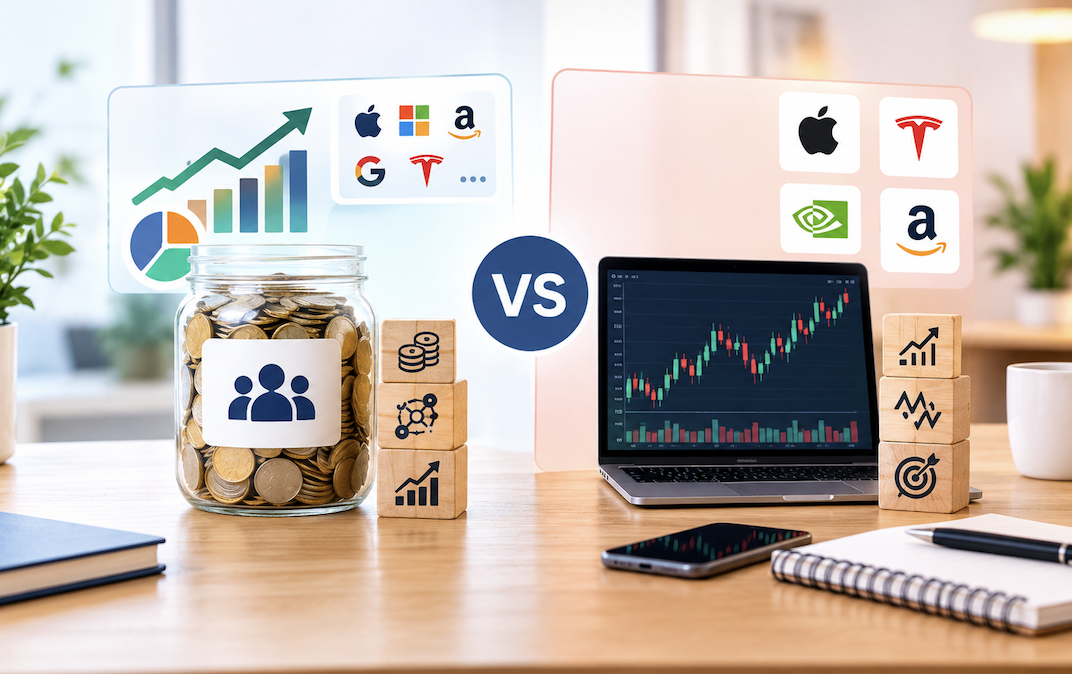
A coworker mentions she’s been buying shares of a single company for two years and is up nearly forty percent. Another friend has been quietly putting money into a broad market index fund every month and can’t tell you what it’s worth without checking an app. Both are investing. Both could end the decade ahead. But the paths they’re on, and the risks they’re carrying, are fundamentally different, and knowing which path fits your own situation matters more than chasing whichever one happened to win this year.
What an Index Fund Actually Holds
An index fund is a pooled investment designed to track a specific market benchmark, such as the S&P; 500 or a total market index, rather than trying to beat it. Buying a single share of an S&P; 500 index fund means owning a tiny slice of all five hundred companies in that index, weighted roughly by their size. The fund’s performance follows the index almost exactly, minus a small management fee. There’s no analyst picking winners inside the fund, a computer program simply rebalances holdings to match the benchmark whenever the index itself changes.
What Buying an Individual Stock Actually Means
Buying an individual stock means purchasing partial ownership in one specific company. That single company’s earnings, leadership decisions, competitive position, and even unrelated news events all directly move the value of your investment. A strong quarterly earnings report can send a stock up double digits in a single day; a product recall or executive scandal can do the reverse just as fast. There’s no averaging effect softening the swings, the stock’s fortune is entirely tied to that one business.
Comparing the Risk Profile of Each Approach
The core difference between these two approaches comes down to diversification, and it shows up clearly once you look at how each behaves under stress.
- An index fund spreads risk across hundreds or thousands of companies, so a single company’s collapse barely moves the total
- An individual stock concentrates all risk in one company’s fate, offering no built-in cushion against bad news
- Index funds tend to recover from broad market downturns as the overall economy recovers over time
- A single struggling company can decline permanently even while the broader market rises around it
This difference in risk doesn’t mean individual stocks are a mistake, it means the potential reward has to be weighed against a much higher chance of losing money on any single pick, especially for investors without the time or expertise to research individual companies deeply.
Where the Return Potential Actually Differs
Index funds are built to deliver market-average returns, which historically have been solid but unspectacular — roughly seven to ten percent annually over long stretches for a broad U.S. stock index, before adjusting for inflation. Individual stocks carry the potential for returns far beyond that average, since a company that grows rapidly and gains market share can multiply in value many times over. That same upside cuts both ways, though: for every stock that delivers spectacular returns, many others underperform the market or lose value outright, and most individual investors have no reliable way of knowing in advance which category a given pick will fall into.
How Much Research Each Approach Actually Demands
Picking individual stocks responsibly requires ongoing research most casual investors underestimate.
- Reading quarterly earnings reports and what’s driving revenue and profit changes
- Following industry trends and competitive threats that could affect the company’s position
- Monitoring management decisions, from major strategic shifts to insider stock sales
- Reassessing the investment thesis regularly rather than buying and forgetting
An index fund requires none of this ongoing analysis, since its entire purpose is to mirror a benchmark automatically. This makes index funds a far more realistic option for people who want market exposure without dedicating serious time to tracking individual businesses.
The Cost Difference Between the Two Strategies
Index funds typically carry very low expense ratios, often a fraction of a percent annually, because there’s no active management involved, just automated rebalancing. Buying individual stocks through most modern brokerages usually carries no direct trading commission, but the hidden cost shows up in time spent researching and in the tax consequences of buying and selling more frequently. Frequent trading of individual stocks tends to generate more taxable events than a buy-and-hold index fund approach, particularly in a taxable brokerage account rather than a retirement account.
Building a Portfolio That Uses Both Strategically
Many experienced investors don’t treat this as an either-or decision. A common approach uses index funds as the foundation of a portfolio, providing broad, diversified exposure to the market’s overall growth, while allocating a smaller portion, often ten to twenty percent, toward individual stocks in companies the investor has researched and feels confident about. This structure limits the damage any single bad stock pick can do to overall savings while still leaving room for the higher upside individual stocks can offer, and it suits investors who enjoy following specific companies without wanting their entire financial future riding on that research being right.
Time Horizon and Emotional Discipline Matter as Much as Strategy
Both approaches demand patience, but they test it in different ways. Index fund investors need to tolerate broad market downturns without panic-selling, trusting that a diversified basket of companies recovers over long time horizons. Individual stock investors face a sharper emotional test, since watching a single holding drop sharply on company-specific news requires distinguishing between temporary volatility and a change in the company’s prospects, a distinction that even professional analysts frequently get wrong. Anyone prone to checking their portfolio daily and making emotional decisions based on short-term price swings generally finds index funds easier to hold onto through market cycles.
Tax-Advantaged Accounts and How They Change the Calculation
The comparison between index funds and individual stocks shifts meaningfully once tax-advantaged accounts like retirement accounts enter the picture. Inside a tax-advantaged account, the frequent trading and dividend reinvestment that would normally trigger taxable events in a standard brokerage account instead grow without annual tax consequences, at least until withdrawal. This changes the relative cost of active stock picking somewhat, since one of the biggest practical drawbacks of frequent individual stock trading, the tax drag from short-term capital gains, simply doesn’t apply inside most retirement accounts.
- Index funds held in a tax-advantaged account still benefit from lower turnover and lower internal fund costs
- Individual stock trading inside a retirement account avoids the capital gains tax consequences of frequent trading
- Required minimum distributions on certain retirement accounts can still create tax events regardless of the underlying investment strategy
- Asset location, deciding which investments go in which account type, can meaningfully affect after-tax returns over time
Many financial professionals suggest holding less tax-efficient investments, including actively traded individual stocks, inside tax-advantaged accounts when possible, while using taxable brokerage accounts for more tax-efficient holdings like broad index funds. This isn’t a universal rule, since individual circumstances like account contribution limits and liquidity needs also factor in, but it’s a consideration worth discussing with a financial professional rather than assuming the same strategy makes equal sense inside and outside a retirement account.
How Market Downturns Test Each Strategy Differently
A market downturn reveals the practical difference between these two strategies more clearly than almost any other market condition. During a broad market decline, an index fund typically falls roughly in line with the overall market, since it holds a representative slice of the entire index. Recovery, historically, has tended to follow broader economic recovery, meaning patient index fund investors who don’t sell during the decline have generally recouped losses over subsequent years, though past patterns don’t guarantee future results.
Individual stocks behave far less predictably during downturns. Some companies with strong balance sheets and defensive business models hold up relatively well, while others, particularly companies already carrying significant debt or operating in more speculative industries, can decline much further than the broader market and, in some cases, never fully recover even after the overall market does.
This divergence is exactly why concentrated individual stock portfolios carry higher risk during periods of market stress, and why investors holding individual stocks need a clearer view of each company’s underlying financial health, not just its recent stock price performance, before deciding whether to hold through a decline or reassess the original investment thesis entirely.
The Role of Dollar-Cost Averaging in Reducing Timing Risk
Both index funds and individual stocks carry the risk of buying at an unfavorable price if a large sum is invested all at once right before a downturn. Dollar-cost averaging, investing a fixed amount at regular intervals regardless of price, is a strategy commonly used with index funds to reduce this timing risk, since it naturally buys more shares when prices are lower and fewer when prices are higher, averaging out the entry price over time rather than depending on a single, potentially poorly timed lump-sum investment.
- Regular, automated contributions remove the emotional decision-making involved in trying to time market entry
- Dollar-cost averaging works particularly well with index funds due to their broad diversification and steady long-term growth pattern
- Applying the same strategy to individual stocks doesn’t reduce company-specific risk, only timing risk
- Automated recurring investments, common in retirement accounts, already implement this strategy without requiring manual effort
This approach doesn’t guarantee better returns than investing a lump sum immediately, research on this question is mixed, with lump-sum investing statistically outperforming dollar-cost averaging in many historical periods simply because markets trend upward over time more often than not. What dollar-cost averaging does reliably provide is a reduction in the psychological risk of large, poorly timed single investments, which for many investors is valuable enough on its own to justify the approach even without a guaranteed return advantage.
Reading a Company’s Fundamentals Before Buying Individual Stock
For anyone choosing to allocate part of a portfolio to individual stocks, a handful of core financial fundamentals makes the difference between an informed decision and a guess dressed up as investing. Revenue growth trends over several years reveal whether a company is expanding its business or merely maintaining it. Profit margins indicate how efficiently a company converts revenue into actual profit, and a declining margin trend, even alongside rising revenue, can signal underlying cost or competitive pressures worth investigating further.
- Revenue and earnings growth trends over multiple years, not just the most recent quarter
- Profit margin trends, which reveal efficiency changes that raw revenue figures alone can mask
- Debt levels relative to earnings, which affect a company’s resilience during economic downturns
- Competitive position within its industry, including market share trends and emerging competitive threats
None of these fundamentals guarantee a stock’s future performance, but ignoring them entirely in favor of buying based on recent price momentum or general brand familiarity is one of the more reliable ways individual investors end up disappointed with concentrated stock picks that looked appealing for reasons that had little to do with the underlying business.
The Behavioral Side of Investing That Numbers Don’t Capture
Financial comparisons between index funds and individual stocks often focus entirely on historical returns and risk metrics, but investor behavior itself is frequently the bigger determinant of actual outcomes. Studies of investor returns compared to the returns of the investments they actually held have repeatedly found a meaningful gap, largely explained by poorly timed buying and selling driven by emotion rather than strategy. An index fund investor who panic-sells during a downturn locks in losses just as surely as an individual stock investor who does the same thing, regardless of which strategy was theoretically sounder on paper.
- The gap between an investment’s return and an investor’s actual realized return is often driven by behavior, not strategy choice
- Automated, scheduled investing removes some of the emotional decision-making that leads to poor timing
- A written investment plan, decided in advance, helps maintain discipline during periods of market stress
- Neither index funds nor individual stocks protect against poor decision-making driven by fear or greed
Recognizing this behavioral dimension is arguably as important as the technical differences between these two investment approaches, since even a theoretically optimal strategy delivers poor real-world results if it’s abandoned at exactly the wrong moment.
Final Thoughts
Neither index funds nor individual stocks are inherently the correct choice, they serve different goals and demand different levels of involvement. Index funds offer built-in diversification and a hands-off path to market-average returns, while individual stocks offer higher potential reward paired with concentrated risk and a real research commitment. Which trade-offs you’re comfortable living with, rather than chasing whichever approach performed best last year, is what actually determines whether a strategy holds up over the long run.
Read more about Newolt
Frequently Asked Questions
1. Which approach is better for a beginner investor?
Index funds are generally recommended as a starting point for beginners because they provide instant diversification and require no company-specific research to maintain. Individual stock investing can be added later, once someone has built a base of market knowledge and developed the discipline to research companies thoroughly before buying.
2. Can I lose all my money in an index fund?
It’s extremely unlikely for a broad market index fund to go to zero, since that would require every company in the index to fail simultaneously. Individual stocks carry a real risk of losing most or all of their value if the underlying company fails, which is one of the central risk differences between the two approaches.
3. Do index funds pay dividends?
Yes. An index fund passes through dividends paid by the companies it holds, typically distributed to fund shareholders on a quarterly basis. The dividend yield reflects a blended average across all the fund’s underlying holdings rather than any single company’s payout.
4. How many individual stocks should someone own to be reasonably diversified?
Financial research generally suggests that somewhere between twenty and thirty individual stocks across different industries is needed to meaningfully reduce company-specific risk through diversification alone, which is a significant undertaking to research and maintain compared to buying a single index fund that already holds hundreds of companies.
5. Is it possible to buy an index fund for something other than the overall stock market?
Yes. Index funds exist tracking specific sectors, international markets, bond markets, and various other benchmarks beyond a broad total market or S&P 500 index. This allows investors to gain targeted, diversified exposure to a particular segment of the market without picking individual securities within it.
6. What fees should I watch for when comparing index funds?
The expense ratio is the main fee to compare, expressed as a percentage of assets charged annually. Even small differences compound significantly over decades, so comparing expense ratios across similar index funds tracking the same benchmark is worth the extra few minutes before choosing one.