
A Major Leap Forward for Intelligent Navigation: Modern navigation demands more than simple directions. Travelers now expect context, recommendations, and real-time insights. Consequently, Google Maps has introduced powerful artificial intelligence features to transform navigation. The new update integrates Gemini AI directly into the platform. As a result, users can now ask complex location-based questions instantly. Traditional map searches required scanning multiple reviews and listings. However, the new system delivers precise answers within seconds.
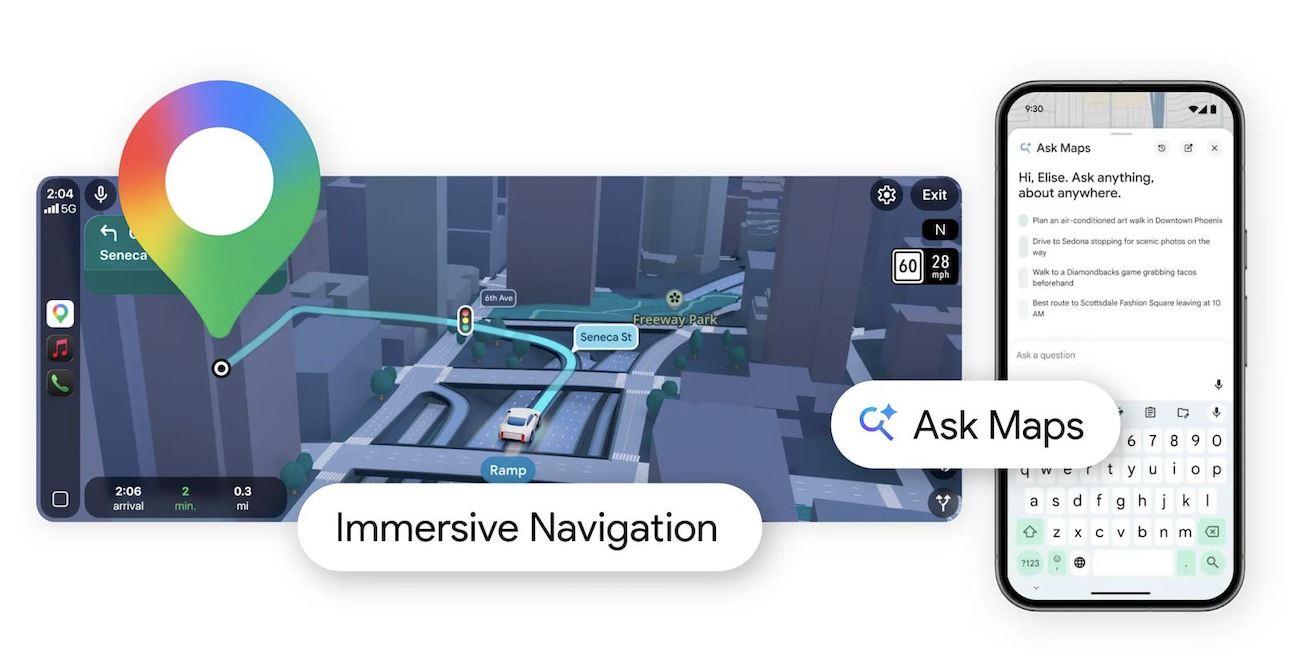
This update introduces two major capabilities. First, the new Ask Maps feature answers complex travel questions. Second, Immersive Navigation offers a realistic 3D driving experience. Together, these improvements reshape how people explore cities, plan trips, and navigate unfamiliar locations.
Ask Maps: AI That Understands Real-World Questions
Ask Maps brings conversational intelligence to digital navigation. Instead of searching manually, users simply ask natural questions. For example, someone might ask for a public tennis court with lights available tonight. Previously, finding that information required searching many reviews. Now, the system instantly analyzes locations and provides the best option. Additionally, Ask Maps displays results on a customized map interface. Therefore, users see nearby locations along with helpful details.
The feature also supports complex travel planning. A traveler can request restaurant recommendations near attractions or parks. Meanwhile, the system organizes the information visually. Furthermore, Ask Maps considers previous searches and saved locations. Consequently, suggestions feel personalized and highly relevant.
The platform analyzes information from more than 300 million places worldwide. Community reviews also strengthen the accuracy of recommendations. As a result, trip planning becomes faster and significantly more efficient.
AI-Powered Trip Planning and Personalized Itineraries
Planning travel often requires multiple apps and research steps. However, Ask Maps simplifies the entire process. Users can request complete trip itineraries based on interests and destinations. The system then organizes attractions, restaurants, and activities logically. Additionally, the AI evaluates location ratings and community feedback. Therefore, recommended places usually match popular visitor preferences. Travelers also receive suggestions for nearby experiences during their journey. For instance, the system might suggest a scenic viewpoint along a driving route.
Moreover, users can explore hidden gems discovered through community insights. As a result, trips feel more authentic and memorable. This intelligent assistance saves time while improving travel quality.
Immersive Navigation: The Biggest Driving Update in Years
Alongside Ask Maps, Google Maps now introduces Immersive Navigation. This feature represents the largest navigation upgrade in over a decade. Traditional navigation often displays simple map directions. However, Immersive Navigation presents realistic three-dimensional environments. Drivers can now see buildings, bridges, terrain, and surrounding structures clearly. Consequently, routes become easier to understand before arriving.
Important road elements also appear in the navigation interface. These include lanes, traffic lights, crosswalks, and stop signs. Therefore, drivers gain a clearer understanding of upcoming road conditions. Additionally, the system shows expanded route previews before driving begins. Travelers can evaluate parking locations and nearby entrances earlier.
This improvement reduces confusion during busy urban navigation.
Advanced Spatial Understanding Powered by AI
Immersive Navigation works through advanced spatial analysis technology. Gemini AI processes large amounts of visual geographic data. Street View imagery provides detailed ground-level perspectives. Meanwhile, aerial photography delivers accurate overhead landscape information. By combining these data sources, the AI builds a comprehensive view of real-world environments.
Consequently, the system understands how roads, buildings, and pathways connect physically. This spatial awareness enables more precise guidance. Drivers can anticipate turns, lane changes, and intersections earlier.
Additionally, the technology improves route comparisons. Users can quickly evaluate traffic tradeoffs between alternate routes. As a result, travelers make smarter decisions before starting a journey.
Smarter Route Planning and Enhanced Driving Insights
Navigation improvements extend beyond visual enhancements. The new system also provides deeper route analysis. Drivers receive more detailed information about upcoming road segments. Therefore, they understand route complexity before reaching difficult areas. Alternative routes also display clearer benefits and drawbacks. For example, one option might save time while another reduces traffic.
Additionally, route previews help drivers prepare for parking situations. Consequently, arrival experiences become smoother and less stressful. This intelligent planning approach enhances both convenience and safety.
Availability and Future Expansion
The rollout of these new features has already begun. Ask Maps is currently launching in the United States and India. Both iOS and Android users will gradually receive access. Meanwhile, desktop versions of Google Maps will gain the feature soon. Immersive Navigation has also started rolling out in the United States. However, not every device supports the update immediately.
Over the coming months, more eligible devices will gain access. The feature will also expand to CarPlay and Android Auto platforms. Therefore, millions of drivers will soon experience smarter navigation.
The Future of AI-Driven Maps
Digital maps continue evolving beyond simple directions. Artificial intelligence now enables contextual exploration and smarter travel decisions. Ask Maps introduces conversational discovery into everyday navigation. Meanwhile, Immersive Navigation transforms route visualization with realistic 3D environments.
Together, these innovations create a powerful travel companion. Users can ask complex questions, plan trips efficiently, and navigate confidently. Consequently, the mapping experience becomes more intuitive and intelligent.
As AI technology continues advancing, map platforms will grow even more capable. Ultimately, navigation may become a fully interactive travel assistant.