
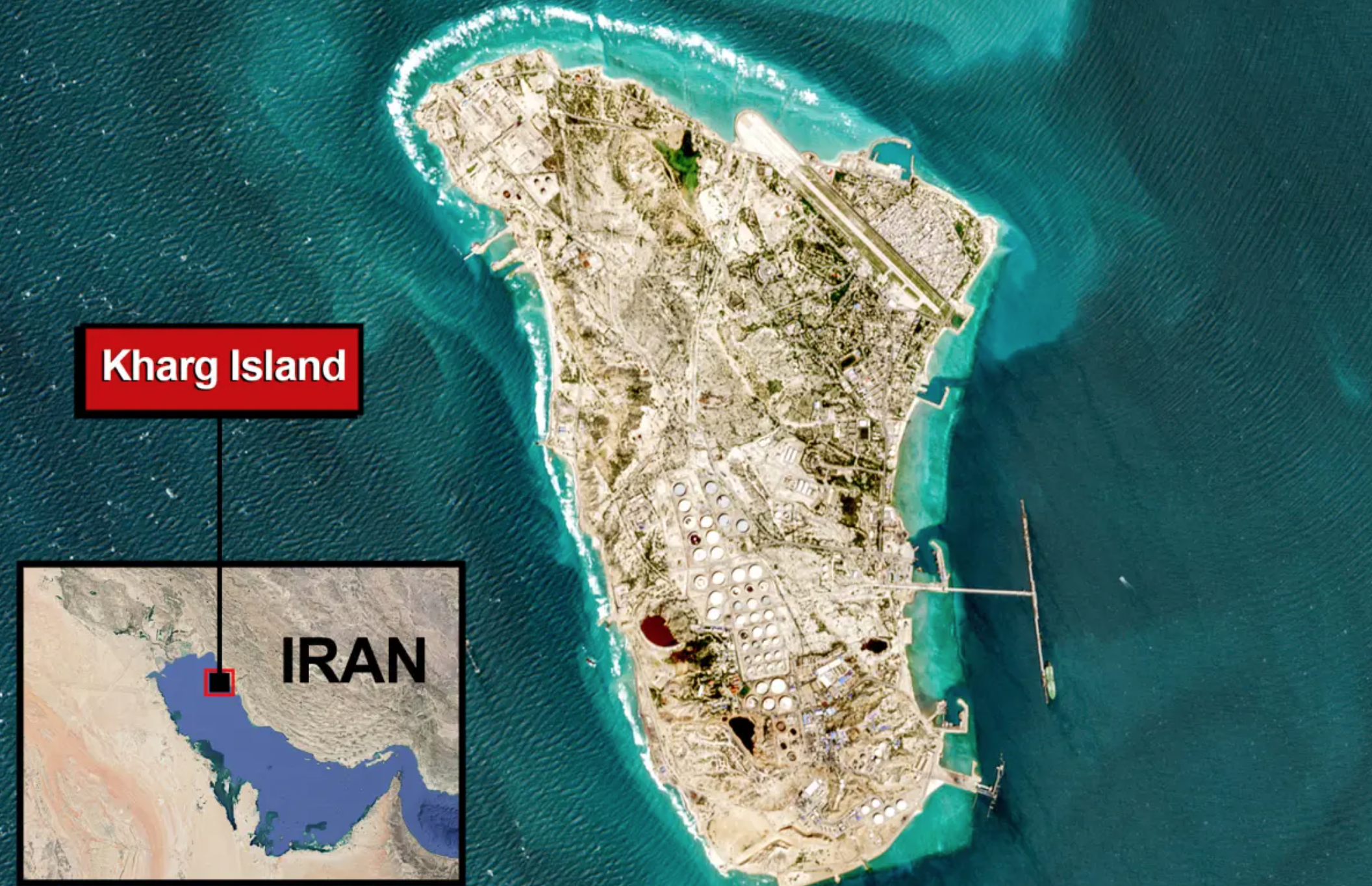
Did you know that the heartbeat of a nation’s economy can be found on a tiny, nondescript patch of coral in the middle of the sea?
It sounds like something out of a geopolitical thriller, but it is reality. Just 25 kilometers off the coast of Iran lies a strategic masterpiece known as Kharg Island.
This small island doesn’t look like much on a map, roughly the size of a small city but it punches far above its weight class. It is the undisputed heavyweight champion of Iran’s energy sector. Without Kharg Island, the Iranian economic engine would grind to a halt. It is the primary gateway for nearly all of the country’s oil exports, making it a lifeline for the regime and a focal point for global superpowers.
But with great power comes great vulnerability. In recent years, specifically amid the rising tensions of the 2026 conflict, Kharg Island has found itself in the crosshairs. It is a place where immense wealth meets imminent danger. So, what makes this island so special? Why do global powers watch it so closely? And how does a 22 square kilometer rock manage to fuel an entire nation? Let’s dive deep into the story, geography, and future of Kharg Island.
The Geography of Power: Why Kharg Island Exists
To understand why Kharg Island is so critical, you first have to look at its physical reality. It is situated in the northern Persian Gulf, about 55 kilometers northwest of the major port city of Bushehr.
Unlike many islands in the region which are mere sandy shoals, Kharg is a continental island composed primarily of rocky limestone and coral. This geological makeup provided the stable foundation needed to build massive industrial complexes.
The Deep-Water Advantage
The island’s “superpower” is its geography. The Persian Gulf is notoriously shallow, which creates a headache for the world’s largest ships. However, the waters immediately surrounding Kharg Island plunge deep enough to accommodate Ultra Large Crude Carriers (ULCCs) and massive supertankers.
This depth means that these vessels can pull right up to the docks and load millions of barrels of crude oil directly. There is no need for expensive, time consuming ship to ship transfers or complicated offshore buoy systems. It is a direct, efficient pipeline from the Iranian soil to the global market.
An Oasis in the Gulf
Perhaps the most surprising feature of the island is its water. In an arid region where freshwater is more valuable than gold, Kharg Island possesses its own natural supply. The porous limestone structure acts as a giant sponge, soaking up rainwater and creating a natural reservoir.
This unique feature allowed humans to settle here thousands of years ago, long before the first oil pipeline was laid. Today, that same water supports a surprising amount of life. Despite the sprawling industrial landscape, the island is home to a population of gazelles, offering a strange, beautiful contrast between nature and heavy industry.
The island’s highest point, Watchman Mountain, stands 70 meters tall. Historically, this was a lookout point for sailors; today, it serves as a vantage point for monitoring the massive maritime traffic that keeps the economy moving.
Kharg Island at a Glance: The Numbers
To truly grasp the scale of operations here, you have to look at the data. This isn’t just a port; it is a logistical fortress.
- Location: 25 km (16 mi) off the Iranian coast.
- Size: Approximately 20–22 square kilometers (about 8 km long and 3–5 km wide).
- Population: Around 8,000 people (mostly workers and military personnel).
- Oil Export Capacity: Capable of handling 7 to 10 million barrels per day.
- Storage Capacity: Can hold roughly 24.5 to 30 million barrels at any given time.
- Security: Heavily guarded by the Islamic Revolutionary Guard Corps (IRGC).
The Economic Lifeblood of Iran
If oil is the lifeblood of Iran, Kharg Island is the heart that pumps it. The statistics are staggering. Oil exports account for roughly half of Iran’s national government revenue. Nearly every single drop of that oil between 90% and 94% passes through Kharg Island.
The China Connection
The destination for the majority of this oil is Asia. China, the world’s second largest economy, is the biggest customer. In recent years, China has purchased nearly 90% of the oil exported from Kharg. This creates a powerful economic symbiosis that helps Iran withstand Western sanctions.
By funneling the vast majority of its export capacity through this single island, Iran centralizes its most valuable asset. It allows them to focus their security efforts on one point. However, this centralization creates a massive economic paradox: Iran’s greatest strength is also its most dangerous weakness.
The High-Value Target
In military strategy, a “center of gravity” is a point of focus that holds everything together. Kharg Island is exactly that. It is a high value target. If the island stops functioning, the Iranian government loses the ability to pay salaries, fund social programs, and finance its military operations almost overnight.
This vulnerability gives the island immense geopolitical leverage. Iran knows that the world knows that an attack on Kharg would be catastrophic for the global economy. Consequently, the threat of disrupting the flow of oil from Kharg is often used as a deterrent in international negotiations. It is the physical manifestation of Iran’s “oil weapon”.
Inside the Machine: How the Oil Terminal Works
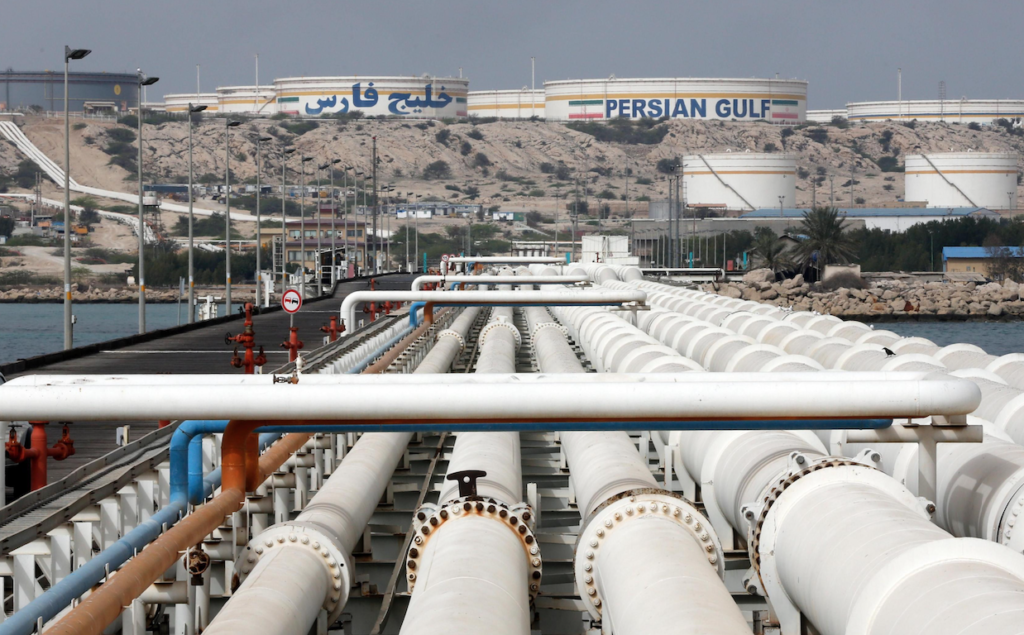
The Kharg Island Oil Terminal is a marvel of 20th-century engineering. It is operated by the National Iranian Oil Company (NIOC) and functions like a well oiled machine iterally. The oil doesn’t just magically appear on the island; it travels hundreds of miles to get there.
The Pipeline Network
Crude oil is pumped from the massive onshore fields in the Khuzestan province. The journey begins at the Ganaveh manifold station on the coast, where three major trunkline systems converge:
The Gachsaran-Ganaveh System: A 30-inch pipeline operational since 1960.
The Agha Jari-Ganaveh System: A 42-inch line built in 1965, which was revolutionary for its time because it used gravity to move nearly a million barrels a day without active pumping.
The Ahvaz-Ganaveh System: Completed in 1972, utilizing massive 42-inch and 48-inch pipes.
From the coast, the oil is pushed through six major submarine pipelines that cross the seabed to the island. This includes a massive 52-inch heavy crude line. Keeping this all moving is the Gurreh booster station, located 40 kilometers upstream. It ensures the oil maintains enough pressure to make the crossing.
Storage and Gravity-Flow Loading
Once on the island, the oil is stored in a farm of 41 massive tanks. These tanks hold a staggering 24.5 to 30 million barrels. In 2025, looking to increase resilience, Iran rehabilitated two massive tanks, adding another 2 million barrels of capacity.
The loading process is brilliantly simple and robust. The storage tanks sit on elevated ground. This clever setup lets gravity handle the hard work. The oil flows down from the tanks to the waiting tankers below. This “gravity-flow” design is a brilliant defensive feature. If the island is hit and loses all electricity, the oil can still be loaded as long as the valves are open.
The Docks: T-Jetty and Sea Island
The loading happens in two main areas:
The T-Jetty: An L-shaped pier on the eastern side with 10 berths. It handles tankers up to 250,000 tons.
The Sea Island: A specialized facility located 2 kilometers offshore in deeper water. This is where the giants dock the 500,000-ton supertankers that the rest of the world can’t accommodate.
Scars of the Past: The Iran-Iraq War
Kharg Island is no stranger to conflict. Its resilience was forged in the fire of the “Tanker War” during the Iran-Iraq War of the 1980s. Knowing that Kharg was Iran’s wallet, Iraqi forces launched a relentless campaign to destroy it. Hundreds of air strikes targeted the island’s facilities and the tankers waiting there. Iraqi fighter jets, including French-made Mirages and Super Etendards, bombed the T-jetty and tank farms repeatedly.
The damage was significant, but the island refused to die. Iranian engineers became legendary for their “battlefield repairs.” They would patch ruptured pipelines and fix jetties under the cover of darkness, ensuring that when the sun came up, the oil could keep flowing. The war taught Iran a harsh lesson: Kharg was too vulnerable to rely on simple defenses. In the aftermath, they invested heavily in surface to air missiles and hardened underground facilities. The protection of the island was handed over to the IRGC, turning it into a “Forbidden Island” where security is absolute.
These historical scars set the stage for the island’s role in modern conflicts, specifically the events of 2026.
The 2026 Conflict: A New Chapter of Warfare
In 2026, Kharg Island once again found itself at the epicenter of a major regional war. This conflict, which erupted on February 28, 2026, saw the United States and Israel launching coordinated operations against Iranian infrastructure.
The March 13 Strikes
The situation reached a boiling point on March 13, 2026. U.S. forces, citing threats to international shipping, launched a massive precision strike on Kharg Island. According to U.S. Central Command (CENTCOM), over 90 military targets were obliterated. These targets included facilities used for storing naval mines and missiles intended to block the Strait of Hormuz.
Interestingly, the U.S. strategy was surgical. They intentionally targeted the military assets-the “guns”, while sparing the oil terminals-the “money.” This was a calculated geopolitical move. By destroying the military threat but leaving the economic engine humming, the U.S. aimed to cripple Iran’s ability to attack while avoiding a global economic meltdown.
However, the warning was clear. President Donald Trump stated that if Iran continued to disrupt shipping in the region, the next set of strikes would target the oil facilities themselves.
A Change in Guard
The 2026 war also brought significant political upheaval. Following the death of Supreme Leader Ali Khamenei in the early days of the conflict, the regime transitioned power to his son, Mojtaba Khamenei. This succession signaled a regime doubling down on security and survival.
The economic shockwaves were felt globally. The uncertainty of war sent Brent crude prices skyrocketing to $115 per barrel in late March. Analysts warned that if Kharg Island’s export facilities were actually hit, prices could spiral to $150 or even $200 a barrel, wreaking havoc on the global economy.
Future Risks and Challenges
Looking ahead, Kharg Island faces a precarious future. The challenges are a mix of military strategy, environmental concerns, and existential paradoxes.
1. The Dilemma of Seizure vs. Blockade
Military analysts are currently debating the best approach for dealing with Kharg in a future conflict. Should an adversary seize the island or simply blockade it?
Seizing the island would give total control over Iran’s economy. But holding it would be a nightmare. With the Iranian mainland only 26 kilometers away, any occupying force would be within range of constant artillery, drone, and missile attacks. A blockade might be safer, but it takes longer to be effective.
2. Environmental Fragility
Beneath the steel and concrete, Kharg is a coral island. The concentration of oil activity in such a sensitive ecosystem is a ticking time bomb. Small leaks are already visible on satellite imagery from time to time. A major strike on the tank farms could result in an oil spill of biblical proportions, devastating the Persian Gulf’s biodiversity.
3. The “Orphan Pearl”
The writer Jalal Al-e-Ahmad once called Kharg the “Orphan Pearl” because of its isolated, rugged beauty. Today, that pearl is encased in industrial armor. The ultimate challenge is whether the island can ever shed its militarized identity. Can it ever return to being a place of culture and nature, or is it destined to remain a forbidden fortress forever?
Conclusion: The Island That Matters
Kharg Island is more than just a dot on a map; it is the nexus of energy, warfare, and survival. It is the story of modern Iran distilled into 22 square kilometers a nation built on ancient history that is now defined by the desperate need to protect and monetize its natural resources.
As long as the oil flows from Kharg, the Iranian regime has a future. But as the events of 2026 have shown, that flow is perpetually at risk. The world will keep watching this tiny coral island, because whatever happens there, the ripples will be felt across the globe.
FAQ’s
What Makes Kharg Island the Economic Lifeline of Iran?
Think of Kharg Island as Iran’s main wallet. It is the primary export hub for crude oil, handling about 90% of the country’s total exports. Since oil makes up about half of Iran’s government budget, the island is critical for paying salaries, funding the military, and keeping the government running. Its deep-water ports are also the only place in Iran capable of loading the biggest supertankers efficiently.
Does anyone actually live there?
Yes, but it’s not a typical tourist destination. According to the 2016 census, about 8,193 people live on the island. Most of these residents are oil workers, engineers, or military personnel assigned to protect the facilities.
What is the “Kharg Island” in video games?
If you are a gamer, you might recognize the name from Battlefield 3. In the game, Kharg Island is a popular multiplayer map that simulates a coastal invasion. It features the island’s harbor, warehouses, and industrial roads, where players fight between an attacking naval force and defending infantry.
What languages are spoken on the island?
The official language is Persian (Farsi), which is used in administration and daily life. However, there is a unique indigenous dialect called Khargi, a Southwestern Iranian language. Sadly, due to the influx of workers from the mainland over the last few decades, the Khargi language is considered endangered.
How does the oil get from the mainland to the island?
Through a massive network of pipelines. Oil is pumped from fields in Khuzestan province to the coast, and then through underwater pipelines to Kharg. A key component is the Gurreh booster station, which keeps the pressure high enough to push the oil across the sea floor.
Is the island safe from attack?
It is heavily defended by the Islamic Revolutionary Guard Corps (IRGC) and equipped with air defense systems. However, its location makes it inherently vulnerable. It has been heavily damaged before (during the Iran-Iraq War) and was targeted again in the 2026 conflict. While it has strong defenses, its proximity to the coast and its value as a target mean it is always at risk.
Read More on Newolt